Swedenborg’s Alien Visions and Exploring the Function of Time in Heaven to Prove his Sanity
June 31, 2024

In modern times, humanity has sent men to explore the Moon, but they’ve found no life there, and neither have any of our high resolution images from modern, powerful telescopes revealed any signs of life anywhere in the universe but on the Earth. How come?
When I first learned about Swedenborg, I remember watching a video overview of him by a secular author who did a summary of him and his life. My initial thought was that his theological teachings were solid and he seemed like a trustworthy person whose books would be worth looking into further…
But… hold on, I thought… what was this that he wrote about having visited aliens and other planets? Is he saying that there is alien life currently in our solar system? He must be crazy.
And what exactly did he say?
Upon further investigation I discovered that he wrote a book about it, called Other Planets (also translated as Worlds in Space and Earths in the Universe) and in the first few paragraphs of that book, he stated:
By the Lord’s Divine mercy I have had my interior faculties, which belong to my spirit, opened, so that I have been enabled to talk with spirits and angels, not only those in the vicinity of our earth, but also with those near other worlds. Since therefore I was desirous of knowing whether there were other inhabited worlds, and what they and their inhabitants were like, I was allowed by the Lord to talk and mix with spirits and angels from other worlds. With some this lasted a day, with others a week, with yet others for months. I was informed by them about the worlds they came from and in the vicinity of which they were, about the life, behavior and religious practices of their inhabitants, and other matters worth relating about them. Since I was allowed to gain my knowledge in this fashion, I can describe them from what I have heard and seen.
It needs to be known that all spirits and angels are from the human race; they are near their own world and know what happens there; and they can inform someone whose interior faculties are open sufficiently to be able to talk and mix with them. A human being is in essence a spirit and associates with spirits at the interior level. Consequently anyone whose interior faculties are opened by the Lord can talk with them, exactly as a man can with another man. I have been permitted to do this daily for the last twelve years.

How do we, as believers, make sense of Swedenborg’s claims of life on other planets, such as Mars, when the NASA Mars rovers send us back photographs like this, showing nothing but barren, lifeless land?
The reason I at first thought this was crazy, and why it was a challenge of faith for me, was because I knew that Swedenborg lived in the eighteenth century, before the invention of modern telescopes, satellites, rockets, and space probes, and, since his lifetime, scientists have sent advanced satellites to other planets in our solar system, which didn’t exist in his time, such as to the Moon, Mars, Jupiter, Saturn, and the others. With Mars, in particular, NASA scientists have scanned and mapped the planet and run remote controlled rovers and helicopters over large portions of it, without finding (yet) any indication of life, let alone intelligent life. They’ve sent men to the Moon, several times, who also found no signs of life. On Google Earth, you can look at the actual topology of both the Moon and Mars, and that makes it appear that they are, in fact, entirely dead spheres.
Yet, Swedenborg goes on in Other Planets #2 and #3 to say the exact opposite of what we’ve since observed about these planets:
In the other life it is common knowledge that there are many planets with people on them and consequently spirits and angels from them. If a love of truth and therefore some useful reason prompts people there to want to talk with spirits from other worlds, they are all allowed to do so. This assures them that there is indeed a plurality of worlds and informs them that humankind exists on not just one earth but countless planets. It teaches them also about the character and life of these people, and about their worship of God.
I have talked with spirits from our earth about this a number of times. We concluded that anyone with a capable mind can see, on the basis of things that are well known, that there must be many planets and they must have people on them. That is, we can determine on rational grounds that bodies as large as the planets — and some of them are significantly larger than our own — are not uninhabited lumps created only to be carried along on a wandering course around the Sun and shed their feeble light for the benefit of just one planet. Their function must be more worthwhile than this.
If we believe, as everyone should, that the Divine created the universe for the sole purpose of bringing humankind into being as the source of heaven (because humankind is the seedbed of heaven), then we cannot help but believe that wherever there is a planet there must be people on it.
As for the objects visible to our eyes because they are within our solar system, we can obviously tell that they are planets from the fact that they are bodies of physical matter. They reflect the light of the Sun, and when we look at them through a telescope they do not look like stars, which twinkle because of their fire, but appear earthlike, with darker and lighter patches. There is also the fact that they, like our own planet, travel around the Sun along the path of the zodiac, which must cause years and the seasons of the year called spring, summer, fall, and winter. Similarly, they rotate on their axes as our planet does, which must cause days and the times of day called morning, afternoon, evening, and night. Not only that, some of them have moons called satellites, which have their own periodic orbits around their sphere the way our moon orbits our planet. The planet Saturn, which is farthest from the Sun, has a huge luminous ring around it that gives a great deal of light to that planet, even though it is reflected light. Can any rational individual who knows all this maintain that these bodies are uninhabited?
“Then we cannot help but believe that wherever there is a planet there must be people on it” and “Can any rational individual who knows all this maintain that these bodies are uninhabited?” Hmm… okay… how do we square this circle?

In the last few decades, the powerful Hubble Space Telescope has allowed scientists to observe the planets in our solar system, and regions beyond, with far more detail than what was available from the small, Earth-bound telescopes in that existed the eighteenth century.
Is the lack of any modern evidence regarding this fact an indication that Swedenborg was lying? Or, perhaps, was he crazy or making it all up? Or was he simply misinformed due to some degree of ignorance and the lack of observational knowledge available to him during his lifetime?
After all, do the the planets in the solar system need to have life on them in order to be considered useful? We know today, for example, that one of the purposes that Jupiter played in the formation of the universe, which allowed life to thrive on Earth, was that its immense gravity allowed it to pull large asteroids and comets into it so that they didn’t smash into Earth. Its gravity, and that of the other planets, helps keep Earth’s orbit around the sun stable, thus keeping it in the Goldilocks or Habitable Zone, the distance from the sun that is the most conducive to temperatures and atmospheric conditions able to sustain the formation of plant, animal, and human life. The other planets in the solar system could also serve other purposes for mankind into the future, such as for mining minerals and raw elements for space travel and colonization.

Swedenborg was aware, however, of the more powerful telescopes of his time and what they were able to observe, such as the one at the Royal Greenwich Observatory in London, and may have tinkered with a few of them.
One of those immediate conclusions, that Swedenborg was crazy, lying, or simply misinformed, may be the first place your mind goes after encountering what he wrote about alien life in the solar system. And, if you are being gracious, you might allow for the possibility of extra-solar civilizations beyond our system, since he also spoke with spirits from distant worlds, yet still hesitate to accept the idea of inhabitants connected with the Moon or Mars. Many scientists today acknowledge that life beyond our solar system is extremely likely, given the sheer mathematical probabilities, while also noting that life within our own system seems improbable based on present observational evidence. And you may be tempted to close the book at this point and set the matter aside.
But before you do, let me challenge you to continue with me further. I want to share how I resolved this apparent issue, along with a few conclusions and conjectures that helped me align modern scientific facts with what Swedenborg said he experienced. It seemed worth doing rather than dismissing him outright. Even as I struggled with this part of his writings, I could not deny that the rest of what he wrote was coherent, logical, and spiritually sound. And because his teachings about humanity carry such depth and clarity, I felt it necessary to look more closely at what he said about other worlds as well, to see if I could understand it rather than setting it aside.
I encourage you to do the same as we begin, and give him and his accounts of the afterlife a fair shake.
I realize many will claim that no one can talk to spirits and angels as long as bodily life continues, or that I am hallucinating, or that I have circulated such stories in order to play on people’s credulity, and so on. But none of this worries me; I have seen, I have heard, I have felt.
Faith Must be Built First on Principles of Love and Only Second on Principles of Science
As we dive into the subject of alien life and of other planets, it can be easy for us to get caught up in the thickets and accidentally try to build our faith based on scientific facts alone. It’s okay to use science to bolster faith, and it’s okay to explore how it makes sense in light of it, which is what we’re exploring today, but not to base the foundation of our faith on it. As Swedenborg often stated, the exercise of building faith on knowledge alone, or on science alone, is fruitless. We must first want to believe in the Divine, as greater than ourselves, and approach life and our understanding of it with a degree of humility that says, I am finite, and so is my brain and my capacity to understand; and, as a finite being, I can never, and will never, be able to fully comprehend an infinite universe so long as I set myself up as the point of origin for truth.
Swedenborg’s revelations regarding the inner sense of the Word accomplish that because with them we’re able to take the Bible not as a scientific book, or examine it under a naturalistic lens, but instead under a spiritual and poetic lens, and then build our understanding of science on that, rather than pitting it against it.
When the Lord’s coming occurs, scholarly study, rationality, and spirituality are going to become one. Scholarly study will then serve rationality, and both of them will serve spirituality.
One of Swedenborg’s callings by the Lord was to make it known that, when examined under the proper light, there is no contradiction between science and spirituality.
And, regarding his book, Other Planets, we should keep the spiritual revelations within it as our ultimate test of authenticity, regardless of any lack of understanding regarding the natural science which Swedenborg may or may not have gotten correct. If some small mishaps regarding the natural science causes us to forgo faith entirely, then we aren’t ready for the Lord to reveal to us his Inner Word. These very mishaps, perhaps, or the mistaken perception of them, act as protection against damage occurring towards heaven by those who are unprepared to enter into its mysteries, since what is natural means nothing to heaven beyond its use for what is spiritual, and what is spiritual is everything and is of the greatest importance.
The worldly and bodily-minded man says at heart, “Unless I am taught about faith and about things that belong to faith by means of sensory evidence so that I see for myself, that is, by facts so that I understand for myself, I am not going to believe.” And he confirms himself in this attitude from the consideration that natural phenomena cannot be at variance with spiritual. Consequently it is from sensory evidence that he wishes to learn about heavenly and divine matters. But this is no more possible than for a camel to pass through the eye of a needle. The more he wants by this method to become wise, the more he blinds himself, until in the end he believes nothing, not even in the existence of anything spiritual or in eternal life. This arises out of the basic assumption he makes. This is eating from the tree of the knowledge of good and evil. And the more he eats of it, the more dead does he become. But the person who wishes to be made wise not from the world but from the Lord says at heart that he must believe the Lord, that is, those things the Lord has spoken in the Word, because they are truths. This is the basic assumption of his thinking. He confirms himself by means of rational, factual, sensory, and natural evidence. And things that are not confirmatory he sets aside.
With regard to Other Planets, following this process is why, despite the apparent inconsistencies in natural science which I first assumed were there, I didn’t allow it to become a block or a barrier of my faith in the Heavenly Doctrine that the Lord revealed in Swedenborg’s works, but instead, I searched out ways to make rational sense of it, based first on core principles in the Word.
Rather than taking it at face value.
The first commandment centers against minor scruples of faith as non-consequential relative to the love of the Lord.
This process of building faith leads to understanding over time. Faith should be affirmed via rational truth vs mere blind authority. The authority that truly builds faith comes from the rational mind within the Word from its center.
This belief in the Word hinges on the love taught in the Word, first, which then helps one inform the science; rather than first needing to inform the science before informing the love (Arcana Coelestia #2588). This is the “affirmative principle;” an attitude you take when outward things are affirmed by inward things, rather than the other way around (Arcana Coelestia #2568).
Some not so upright spirits who were once with me for quite a time were constantly introducing doubts that were based on the illusions of the senses and went against the idea that all things can flow in from a single source, and so from the Lord. But I told them that so many doubts could not be removed in a short space of time, on account of the illusions of the senses which had to be dispelled first and on account of their lack of knowledge of countless things which they needed to know first. Indeed I told them that with people who have a negative frame of mind, that is, who are ruled through and through by a negative attitude, doubts cannot by any means be removed; for with these people one small difficulty has more validity than a thousand proofs. With them one small difficulty is like a grain of sand placed right in front of the pupil of the eye, and although it is only a single grain and very tiny it nevertheless blocks one’s entire field of vision. But people who have an affirmative frame of mind, that is, who are ruled through and through by an affirmative attitude, turn away small difficulties which are based on the illusions of the senses and go against truths; and any things they cannot grasp they cast aside, saying that they do not yet understand them, and in so doing hold fast to their belief in the truth. But the spirits mentioned above paid little attention to what they were told because of their negative frame of mind.
This is crucial with regard to the issues I presented regarding Other Planets: The issues I pointed out above, I believe I’ve solved below in this article, and I will explain them, but even if I haven’t solved them adequately enough to convince you, the argument remains that they would remain as insignificant scruples placed off to the side, as we know based on the inner sense of the Word that Swedenborg explains, which is all loving, spiritual, moral, and civil — and which I’m fully confident in — that misunderstandings regarding the natural science that may not yet be fully understood will be explained in time, whether in this life or in the next.
Recently I had a discussion with someone online about this. He said in the comments, “Swedenborg also saw that little men with Swedish* caps live on the Moon. Why does anyone still believe in his visions?”
My response was:
He wrote about people living on the Moon in the spiritual world, not in the physical world. A strange particular of faith like this, however, has no bearing on religion. In heaven, the only thing that matters is love and wisdom, and that forms the core of the doctrine there.
*Swedenborg said they were wearing mossa which is Swedish for “caps” but not specifically “Swedish caps” and so he didn’t infer that the Moon-people were from Sweden, and thus not necessarily from his era either (See Spiritual Experiences #3242).
The Pale Blue Dot
The fact is, no matter how smart or how educated we become, we’ll always be, as the astronomer Carl Sagan once said, nothing more than a little spec of dust on a tiny blue marble, a “pale blue dot,” in a huge sea of space that spans trillions of light years.

The tiny little dot to the right of the image, is Earth, as was seen from the Voyager 1 spacecraft in 1990.

“Looking Back from Space” by Cary Judd, was themed after Carl Sagan’s quote. (Link)
We succeeded in taking that picture [from deep space], and, if you look at it, you see a dot. That’s here. That’s home. That’s us. On it, everyone you ever heard of, every human being who ever lived, lived out their lives. The aggregate of all our joys and sufferings, thousands of confident religions, ideologies and economic doctrines, every hunter and forager, every hero and coward, every creator and destroyer of civilizations, every king and peasant, every young couple in love, every hopeful child, every mother and father, every inventor and explorer, every teacher of morals, every corrupt politician, every superstar, every supreme leader, every saint and sinner in the history of our species, lived there on a mote of dust, suspended in a sunbeam.
The Earth is a very small stage in a vast cosmic arena. Think of the rivers of blood spilled by all those generals and emperors so that in glory and in triumph they could become the momentary masters of a fraction of a dot. Think of the endless cruelties visited by the inhabitants of one corner of the dot on scarcely distinguishable inhabitants of some other corner of the dot. How frequent their misunderstandings, how eager they are to kill one another, how fervent their hatreds. Our posturing, our imagined self-importance, the delusion that we have some privileged position in the universe, are challenged by this point of pale light.
Unfortunately, until we realize this, we’ll never be able approach the subject about other life in the universe with the degree of humility and acknowledgment necessary to accept that the Lord is the point of origin for it all and that we’ll never be able to understand or prove his existence in its entirety, neither the lack of it, based on science and facts alone. No matter how much we learn, there will always be something new to learn.
It is, however, a common saying that no one can comprehend spiritual or theological matters because they transcend human understanding. Yet spiritual truths are as comprehensible as natural ones. And if they are not clearly understood, still, when they are heard, it falls within its scope of the intellect to perceive whether they are true or not. This is especially the case with people who have an affection for truths.

“To my mind, there is perhaps no better demonstration of the folly of human conceits than this distant image of our tiny world. To me, it underscores our responsibility to deal more kindly and compassionately with one another and to preserve and cherish that pale blue dot, the only home we've ever known.”
—Carl Sagan
And, since we can’t use science and facts to prove that he exists, then we need to look to something deeper, that is, towards caring, intentionality, and love.
Whether you believe Swedenborg, including whether you believe in the Word or not, and thus in the Lord, has little to do with whether or not you can piece together the science, unless you have first pieced together the spirituality. Faith, in order to be sincere, has to be based first within principles of love from the Word.
To put it another way, do you believe what the Lord taught was good? If so, do you think that is the most important thing?
Love really is the point of origin for everything, because as we seek to understand the universe more, and as we seek to understand other humans and ourselves more, then we are also seeking to understand the Lord more, and without that point of origin, everything is meaningless. The very act of placing our point of origin in love towards the Lord allows us to understand him better, because the more we love him, the more we learn and seek to understand him with an open heart and mind, making him and his infinite wisdom our point of origin rather than ourselves and our tiny source of finite wisdom. This allows us to grow into his infinite wisdom one step at a time. But without that, we block ourselves from progressing.
Today certain people even wanted to enter into the innermost mysteries of faith…
And I was allowed to portray to them the little seed of a tree by a symbolic mental image, saying that if they were told that the little seed produces an entire blossoming tree, which was also portrayed to them live, with branches, leaves, and fruits — indeed, that such a little seed can produce even an entire field full of trees, thus if they were told that such a little seed would produce all that, and nevertheless they cannot see anything in the seed nor know the causes by which all this comes forth, it should not on that account be denied, for the truth has been demonstrated.

So the truths declared by the Lord, and those concerning the Lord, must be believed even if we do not fathom them with our reason. And to want to deny them because we do not penetrate them with our reason is the same as wanting to deny the procreation of trees from seeds, and of animals from eggs — so in a thousand other cases. This shows what the faith of people is like when they believe nothing except what they see, which is the usual thing today, especially among the academics of the world.
If you get that far, then it makes more sense to go forward with science, trying to piece together how it does, or might, fit in with the Logos of the Lord and his plan. Once you reach that point, you’ll be able to make sense of it while also taking in everything you hear about science, or the lack of it, with a grain of salt, because, although interesting and still potentially useful to explore, it’s all relatively trivial in comparison to the principal goal. With this realization, despite any confusion about how life in the universe all came together, you trust that everything in the universe is working together for the good of life, even if it doesn’t make sense yet.
You’re an interesting species, an interesting mix. You’re capable of such beautiful dreams and such horrible nightmares.
You feel so lost, so cut off, so alone.
In all our searching, the only thing we found that makes the emptiness bearable, is each other.
But, “Just Have Faith” Isn’t Quite the Answer
Before going further, it is important to distinguish between faith that begins from love of truth and humility toward the Lord, and faith that refuses to examine anything. The first is the true foundation of spiritual life; the second is merely accepting dogma without understanding. For this reason, it is not enough within the New Church simply to say, “just have faith,” if by “faith” we mean unquestioning acceptance without any personal search for truth.
It is one thing to choose to believe because the Word teaches something and because spiritual principles anchor that belief, but it is another thing to stop there and never investigate further. Once faith is grounded in love of the Lord and openness to truth, we are meant to examine, to consider, and to prune the tree of our own thoughts and intentions so that our understanding grows in harmony with our faith.
Real faith is nothing else than an acknowledgment that a thing is so because it is true. For someone who possesses a real faith thinks and says, “This is true. Therefore I believe it.” For faith is a faith in the truth, and truth is the object of faith.
By the same token, if the same person does not understand a thing to be true, he says, “I do not know whether it is true. Therefore I do not yet believe it. How am I to believe what I do not comprehend? Perhaps it is not true.”
So, yes, faith must begin in love, but without wisdom it is easily misled. Just because someone teaches something does not make it true. A certain degree of skepticism is healthy, because it is one of the ways the Lord helps us build discernment and deepen the application of love in our lives.
Most of us have been misled at some point by people who used spiritual language for selfish ends, and this makes it understandable if you approach extraordinary claims with caution. Throughout history, malicious people have twisted the Lord’s teachings into false ideas, harming the trust of many and closing them off from truths that could have blessed them.
Swedenborg wrote:
Let me take this opportunity to tell how things work out in the other life for scholars. On the one hand I wish to say how it is for those scholars who gain understanding through their own reflections and are motivated by a love of knowing what is true for its own sake and therefore for some purpose beyond worldly considerations. On the other hand I wish to say how it is for the scholars who base their work on what others have done without reflecting on it for themselves. This latter practice is typical of people who want to know what is true solely for the sake of their own reputation as scholars, to get from it respect or wealth in this world; and therefore for no purpose beyond worldly considerations.

He then went on to write about Aristotle, noting how Aristotle reached his conclusions through careful reflection and personal investigation, while many of his later followers simply repeated his ideas without understanding them. They read him in order to sound smart, not because they loved truth for its own sake.
If I had taken that same approach whenever someone told me to “just have faith,” I might have remained a Mormon, accepting teachings that did not withstand deeper spiritual or historical scrutiny. Teachings in the Pearl of Great Price about Egyptology, or about the planet Kolob, would have passed without question. If I had stopped thinking there, everything Swedenborg wrote would have remained science fiction to me rather than true spirituality. And we all know that similar dangers exist elsewhere. We would be equally vulnerable if we took the claims of Scientology at face value, or the claims of any religion, without examining whether they lead toward spiritual good or are principally concerned with worldly advantage.
This is one reason I believe Swedenborg today and not Joseph Smith. It is not a matter of where their followers eventually went, since anyone’s teachings can be distorted by those who approach them for selfish ends. Rather, it is a matter of the teachings themselves when examined spiritually and objectively. Smith’s doctrines, when weighed in that light, turn the mind toward worldliness and moral permissions that break the order of marriage into eternity, whereas Swedenborg’s remain within the Lord’s design for a single, spiritual union, even when he describes states of disorder or their remedies. Swedenborg’s writings draw the mind toward charity, repentance, and the pursuit of spiritual truth. What is truly spiritual draws its life from the Lord, and therefore reveals his influence. That is the standard by which I measure these things, and it is the same standard by which I approach the Word itself.
First of all one should get to know what the Church teaches; then one should discover from the Word whether such teaching is the truth. For things are true not because they are what leaders of the Church have so declared and their followers uphold. If that were so one would have to say that the teachings of any Church or religion were the truth simply because they are those of a person’s native soil and are those into which he was born. Thus not only the teachings of Papists or Quakers would be true but also those of Jews and of Mohammedans too since their Church leaders have so declared and their followers uphold it. From all this it is evident that one should search the Word and there see whether what the Church teaches is the truth. When an affection for truth motivates the search a person receives light from the Lord so that he may discern, though unaware of the source of his enlightenment, what the truth is, and may be assured of it in the measure that he is governed by good.
…But very few at the present day proceed in this way, for the majority of people who read the Word are not motivated by a desire for truth when they read it but by a desire to endorse the teachings of the Church in which they were born, no matter what those teachings may be like.
…From all this it may now be evident that factual knowledge should not on any account be cast aside from the truths of faith but should be joined to them. But one should go the primary way, that is, the way that begins with faith, not the secondary way, that is, the one that begins with factual knowledge.
So, when we examine unfamiliar subjects concerning the universe, we must base our faith on first principles drawn from the Word, not on scientific theories alone. Yet once that foundation is in place, we can look at the science surrounding these questions and consider how it may harmonize with what Swedenborg experienced. This allows us to expand our understanding as far as natural truth can reach, while keeping spiritual truth as the heart and guide of the inquiry.
In this way, what Swedenborg wrote about other planets and other human races can be joined to faith rather than pushed to the margins of belief. With that in place, we can now explore where spiritual principles and scientific reasoning meet.

High resolution image of Jupiter, taken by the Juno Spacecraft.
How I’ve Resolved These Issues
Swedenborg didn’t actually say that he saw the physical aliens from the planets he mentions, only the spirits of those departed from them.
Under the Lord’s guidance I was taken by angels to a world in the starry sky, where I was allowed to look at the world itself, but not to talk with its inhabitants, only with spirits from it. All the inhabitants or people of each world become spirits when their life in the world is over, and they remain in the vicinity of their own world. I was, however, able to gather information from them about their world and the condition of its inhabitants. For when people leave the body, they take with them their whole previous life and everything in their memory.
And so this makes it clear that he was describing an ability to see into the memories of those spirits and the condition of their planets as those planets were during their natural lives, not as they exist now. He may not have been shown the present condition of those worlds, or he may not have been permitted by the Lord to record such details, because revealing them could interfere with the natural course of scientific discovery in our own timeline.
Neither did he say he actually saw the physical planets of our solar system in his spiritual experiences, only the spiritual analogues of them.

Being taken to worlds in space does not mean being taken or traveling in body, but in spirit. The spirit is guided through varying states of inner life, which appear to him like travels through space. Agreement or similarity in states of life determines how close people come, for agreement or similarity of life links them, disagreement or dissimilarity separates them. This can allow it to be seen how travel in spirit takes place, and how one can approach distant places, while the person still keeps to his same place.
There is ample testimony from around the world of people who have had near-death experiences and encountered realms beyond the physical one, so accepting the idea of spiritual worlds inhabited by human life is not a large leap. It is far easier to conceive of life in the spiritual world associated with the planets of our solar system than to imagine life on the physical planets themselves, because the world of the mind and spirit is not bound by the laws of physics.
Even so, this still leaves an important question. The spirits Swedenborg met from those worlds had lived natural lives before entering the spiritual world, as he plainly stated. That means they did inhabit a physical environment at some point prior to passing on. How do we account for that?
We will address that question shortly when we examine the reality of how time functions compared with how it appears to function. For now, stay with me.
Our solar system, being billions of years old, may have supported humanoid life at some time in its distant past on planets other than Earth, even though it doesn’t appear to today. The sun and our solar system, when it was younger, was in a different state of formation which may have allowed for life to form on planets closer to it, such as Mercury and Venus.

Mercury may once have had a very different state in the distant past, perhaps millions or even billions of years ago. Its orbit may not always have been as close to the sun as it is today, and the sun itself was not always in its present condition. If the early sun was smaller or cooler, or if its radiation output was lower, Mercury might have retained an atmosphere capable of moderating heat across its surface. An atmosphere would also have created a more stable climate with far less temperature variation between day and night.
One interesting detail is that a full year on Mercury is about 88 Earth days, while a full day is about 176 Earth days. If natural conditions ever allowed human life there — whether in the distant past or at some future stage of the planet’s development — such inhabitants might have lived in a nomadic pattern, continually moving to avoid the most intense direct heat of the sun. With such long days and years, they would have had far more time to adjust their location before the climate shifted. Swedenborg’s description of the spirits who came from Mercury, who wander and travel rather than settle in one place, resonates with this idea; except that they now roam the spiritual universe rather than their former natural world (Other Planets #24).
About Mercury’s climate, Swedenborg wrote:
They went on to say that their climate was temperate, neither too hot nor too cold. I was allowed to tell them that this was the Lord's providence, to prevent an excess of heat due to their world being nearer the sun than the other planets. Heat is not the result of proximity to the sun, but depends on the thickness and density of the atmosphere, as is plain from high mountains being cold even in hot climates. Temperature is also regulated by the directness or obliquity of the incidence of the sun’s rays, as is evident from the seasons of winter and summer in any one region.
A similar idea applies to Venus. NASA’s research suggests that Venus may not always have been as hot as it is today. Some evidence indicates that its ancient surface may once have supported water and been more temperate. Scientists understand Venus’s present state as the result of a runaway greenhouse effect — an extreme version of global warming caused by a buildup of atmospheric gases. But this condition may not have existed in the past, and may not persist into the far future. As the sun evolved, the habitable zone around it may have shifted. Just as Earth occupies that zone today, Mercury or Venus may at one time have occupied it, and might again at some later stage of cosmic time. And humanity may eventually learn how to regulate or terraform planetary climates in ways we cannot yet imagine.
We already see dramatic climatic shifts on Earth from changes in orbit, axial tilt, and atmospheric composition. Over relatively short periods — a few thousand years — the Earth has moved in and out of ice ages, reshaping much of the planet. If Earth can change so radically in such a short geological window, it is not unreasonable to consider that Mercury and Venus could have had very different conditions thousands, millions, or billions of years ago compared to what we observe today.
The Moon may have at one point been its own planet.
One of the hardest aspects of Swedenborg’s writings on other worlds in our solar system to come to terms with is what he said about the Moon, since he reported that other lifeforms had lived there. Unlike some other bodies in the solar system, the Moon’s surface has been directly explored. Since Swedenborg’s time, we have photographed its surface in high resolution, sent rovers, and even sent humans who walked on it. No life was found, and we know that the Moon has an extremely thin atmosphere incapable of supporting life as we understand it today.
As with Mercury, one might speculate that the Moon could once have had an atmosphere that it later lost — but there is another idea worth considering. Since the 1970s, many planetary scientists have proposed that the Moon originated from a violent collision between Earth and a Mars-sized protoplanet often referred to as Theia. According to this hypothesis, materials from both bodies were mixed together in the impact, eventually forming the Earth and the Moon as we know them today. In such a collision, any atmosphere Theia possessed would have been stripped away. The hypothesis is supported by lunar rock samples brought back during the NASA Apollo missions, which show a striking similarity in composition to Earth’s mantle, suggesting a shared origin rather than having formed elsewhere and later been pulled into Earth’s orbit.
With that in mind, one possible explanation of Swedenborg’s reports is that life may have existed on the planetary body associated with the Moon during an earlier stage of its history, before the collision that reshaped both Earth and the Moon into their present forms. If such life existed millions or billions of years ago, any physical evidence of it would almost certainly have been erased by the impact itself and by subsequent geological processes. In that case, the absence of surviving evidence is expected rather than surprising. The lack of empirical proof, therefore, is not a sufficient reason to dismiss Swedenborg’s account as irrational, but instead reflects the limits of what can be recovered from events so distant in time.
It is also possible that, in the spiritual world, this former planetary body is now referred to as the Moon because of its present relationship to Earth, even if during the time it supported natural life it was not yet orbiting our planet. Swedenborg himself consistently distinguished between how things appear in the natural world and how they are named and perceived in the spiritual one.
I have another theory regarding Swedenborg’s descriptions of spirits from the Moon that may be just as plausible, if not more so, given the way he characterized them, which I will address shortly. I wanted to introduce the idea of Theia first in order to highlight the complexity of planetary history. Our solar system has undergone dramatic transformations, collisions, and losses over immense spans of time. Many such events leave little or no recoverable trace. Some aspects of that history may never be fully reconstructed, no matter how advanced our instruments become.
As the sun ages, expands, and grows hotter, it may one day, billions of years from now, make the outer regions of the solar system more hospitable to life than they are today.

The star known as Betelgeuse, a red supergiant, is an example of just how large stars can become as they age. From Wikipedia: “With a radius around 640 times that of the Sun, if it were at the center of our Solar System, its surface would lie beyond the asteroid belt and it would engulf the orbits of Mercury, Venus, Earth, and Mars.”
Planets and planetary systems far from the sun, such as those associated with Jupiter, Saturn, Uranus, Neptune, and even Pluto, may one day receive levels of warmth very different from what they experience now.
Just as life may have existed in the distant past on Mercury or Venus before conditions there changed, so too the outer solar system may represent a different stage in a much longer process. Planets and moons that are presently cold and hostile could be awaiting a future state in which the sun’s expansion makes them more suitable for life.
Jupiter itself illustrates why this idea can seem implausible at first glance. It is a gas giant with immense gravity, no solid surface, violent storms, and intense radiation, none of which are conducive to humanoid life as we understand it. In its present state, Jupiter is clearly inhospitable.
That said, this may simply reflect a particular phase in its development rather than its entire history or future. When Swedenborg wrote about life associated with Jupiter and Saturn, he may have been referring not to the planets themselves, but to their moons. Bodies such as Europa, Titan, Enceladus, Ganymede, Io, and Callisto are widely considered far more plausible candidates for life, either in the past or under different conditions. The large outer planets function almost like miniature solar systems, each surrounded by dozens of moons. Some of these moons may once have had atmospheres, internal heat, or chemical conditions very different from those we observe today.
We simply do not know what states these moons may have passed through billions of years ago, or what gravitational, elemental, or atmospheric forces once shaped them. It is not difficult to imagine a moon orbiting Jupiter with a thick atmosphere, receiving less solar radiation than Venus, yet maintaining a temperate environment suitable for life during some distant period of its history.
What It Means to Be Human
To be “human” does not mean merely to possess a physical body. Rather, it means to have lived a mortal life in which free will was possible, and to possess a spirit capable of rational thought about God. In Swedenborg’s terminology, a “human being” is any life form that serves as a living vessel receptive of love flowing in from the Lord.
In Swedenborg explains:
For a human being is a human being by virtue of the will… And as the will is really the human being, “human being” therefore means the good of love, since it belongs to the will, perfecting and composing it.
From this perspective, the “human form” is not defined by outward appearance alone. It is any intelligent form of life capable of contemplating God and receiving life from him. Such a form may take on a physical shape of some kind, but it doesn’t need to look exactly like the human body as we know it on Earth.
Swedenborg continues:
Whereas “a man” is such by virtue of the understanding… For the meaning of “a man” is the power of understanding and consequently the truth of faith.
And because wisdom and understanding constitute what is truly human, angels and good spirits are, in this sense, more fully human than people still living in the natural world, since they dwell more completely in the light of wisdom.
And since understanding and wisdom are what make people human, not shape, good spirits and especially angels are more human than people who still have their bodies, because they have more of wisdom’s light.
As Swedenborg candidly admitted:
For because I am unable to form a picture of people other than those who live on planets surrounded by an atmosphere, therefore, although this is unknown to me because I cannot imagine it, I do not want to reject it out of hand. For bodily shapes are entirely according to the condition of the atmospheres and many other circumstances on the planets where they are.
The essential point is this: what makes a being human is not physical resemblance, but the capacity for free will, understanding, and love directed toward the Lord. Wherever such life has existed, whether on Earth or elsewhere, it belongs to the one human race and has its place within the Grand Human of heaven.
This clarification is necessary because many people in the seventeenth and eighteenth centuries, and still today, believed that after death human beings became something vague or ethereal, like a wisp or a disembodied essence, which couldn’t be fully visualized or pictured in one’s mind. Others believed that angels belonged to a separately created race, distinct from humanity altogether.
Swedenborg clarified that all angels once had a mortal body, and whether or not that mortal body lived on Earth or on another planet, they all lived a mortal life, like we all do on Earth, before dying and taking with them their spiritual form, similar to a blueprint of the body they had adhered to during their mortal life, albeit with new, spiritual brilliance and enhanced senses and abilities. Since there are so many different races of species in the universe, he wrote, “they’re all from the human race,” in order to emphasize the fact that they all lived a mortal life before they received an immortal one, and that they all exist within the Grand Human of the Lord, rather than having been created as immortals in some pre-existent state before the Earth was created. The idea of a pre-existence, he wrote, isn’t true.
This point is confirmed in his report of spirits from Jupiter:
They [spirits from Jupiter or one of its moons] also said that very many inhabitants of their planet believe that the spirits within their bodies have existed from eternity, being instilled into the body at conception. But they added that they now knew that this was untrue and that they regretted having possessed such a false notion.
The idea of a pre-existent life before being born on Earth is not actually taught in the Bible. Some interpret Isaiah 14:12-15 as indicating that there is a pre-existence, which mentions Lucifer being cast down from heaven before the creation of the earth, but Swedenborg points out that we’re supposed to interpret the words of the biblical prophets poetically according to correspondences, rather than literally. Lucifer represents a group of people who profane the Word, rather than a single, literal person. To fall away from heaven means to distance oneself from God. The Isaiah passage really has nothing to do with a pre-existence, but rather, it’s an allegorical story that teaches us about the state of people’s hearts during mortal life and thereafter.
Historically, much of the imagery surrounding a pre-existent war in heaven appears to have entered the Christian imagination through extra-biblical writings, such as the pseudepigrapha, especially the Book of Enoch, which describes the rebellion of the Watchers. These ideas were later popularized in literary form, most famously in John Milton’s epic poem Paradise Lost, published in 1667, twenty-one years before Swedenborg’s birth. Although Milton’s work is a masterpiece of English literature, it is not scripture. Yet its vivid portrayal of a primordial angelic rebellion became deeply embedded in the Christian psyche, often being taken as doctrinal fact rather than poetic fiction. Similar narrative frameworks later appeared in various religious and fictional systems, including the LDS Church’s Book of Abraham and modern fantasy literature. Swedenborg’s insistence that angels are former humans, and that there is no pre-existence, was therefore a necessary correction of ideas that were already becoming widespread in his day due to Paradise Lost, but were not grounded in the Word.
This correction is also crucial because false ideas about pre-existence easily give rise to false ideas about predestination. Swedenborg rejected both.
Swedenborg wrote:
A discussion about predestination once took place and many of the spirits, owing to the chief ideas they had adopted in the world, were of the opinion that some people have been predestined to heaven and others to hell. But I heard a response to this from heaven, which was that no one has ever been predestined to hell, but that all have been predestined to eternal life.
Whether or not they choose to align with that predestination towards eternal life, however, is up to each individual, since everyone retains their free will.
Returning, then, to the question of life on other worlds, Swedenborg acknowledged that the universe contains an immense variety of species and forms. Because of this, it is impossible to imagine or describe them all precisely. Some forms of life may have bodies shaped very differently from our own, depending on the atmospheres and conditions of the planets on which they lived. Yet regardless of outward form, all such beings share the same essential qualities: a mortal life, freedom of choice, rational thought, and receptivity to life from the Lord.
Planets do not need to be currently supporting life in order to have the purpose of supporting life overall.
Some English translations of Swedenborg may overstate his meaning in places, especially where planets are described as having inhabitants.
As Swedenborg noted earlier, a planet does not need to have an atmosphere, or at least not one familiar to us, in order to support life. Even so, one cannot expect a planet to support life at every moment of its lifespan. Most planets begin in a state of volcanic or elemental chaos and undergo long processes of formation before they become suitable for habitation. Like a building, a planet must first be formed before it can reasonably be inhabited, and it may also undergo periods of change or renewal. As Swedenborg observed, divine providence does not necessarily proceed in a simple linear order (Arcana Coelestia #6487).

Even when each planet in our solar system is undergoing a state whereby it’s void of human life, as appears to be the case for all of them but Earth at the moment, each nonetheless has the purpose for it overall. And even if a planet or any celestial body is destroyed before ever being inhabited or used directly by human beings, it still has a universal purpose for human life according to the Lord’s eternal foresight, all the reasons of which are not apparent to us in the moment. Many stars and their orbiting planets are recycled, for instance, through supernovae, which afterwards produce rare minerals that seed other planets with elements useful for life and civilization.
With this in mind, it seems that several English translations of the passage cited earlier from section three may be more definitive than the Latin requires. Consider the following renderings:
From the 1892 Earths in the Universe: “he… must needs believe also, that wherever there is an earth, there are men.”
From the 1997 Worlds in Space: “he… must inevitably believe that, where there is a world, there must be human beings.”
From the 2020 Other Worlds: “…then we cannot help but believe that wherever there is a planet there must be people on it.”
Each of these translations uses indicative language (“are,” “must be”) which presents the statement as an established fact. The Latin, however, allows for a slightly different reading. The text reads:
non potest non credere, quam quod homines sint, ubicunque aliqua Tellus.
The verb sint is subjunctive. While the subjunctive here does not necessarily imply doubt, it does suggest a rational inference rather than an empirical claim. It can reasonably be understood as expressing plausibility grounded in reason rather than certainty grounded in observation.
Read this way, the clause should be rendered as:
He cannot but believe that there may be humans wherever there is any land.
This preserves the rational structure of Swedenborg’s argument without requiring that every planet be presently inhabited. And it’s the only rendering that makes sense, given what we know today about the empty state of the other planets in the solar system.
A similar issue arises with another clause in the same work.
From the 1892 Earths in the Universe: “Who that knows these things and from reason thinks about them can say that these are empty bodies?”
From the 1997 Worlds in Space: “Can anyone knowing this and able to think rationally still claim that these are empty masses?”
From the 2020 Other Worlds: “Can any rational individual who knows all this maintain that these bodies are uninhabited?”
The Latin reads:
Quis usquam, qui haec novit, et ex ratione cogitat, dicere potest, quod haec inania corpora sint?
The key word here is inania. While often translated as “empty,” inania can also mean vain, useless, or unformed. In other words, it can describe something that lacks present fulfillment rather than intrinsic value. An alternate translation that avoids contradiction with the present state of the Moon or Mars would be:
Who anywhere, who knows these things and thinks from reason, can say that these may be worthless bodies?
Understood this way, Swedenborg is not denying that planets may appear empty at a given time, but rather rejecting the idea that they are purposeless. His point is that a person reasoning properly must conclude that even if such bodies are presently empty, they are not therefore worthless, but exist for a higher purpose than merely revolving around the sun.
This would have been obvious to him. By Swedenborg’s time, telescopes were already good enough to show that the Moon was barren, airless, and geologically inactive. Galileo had published detailed lunar observations more than a century earlier, and by the eighteenth century it was well understood that the Moon lacked clouds, weather, seas, or visible signs of life. Swedenborg himself was a trained scientist and engineer and would certainly have been familiar with those observations.
That’s precisely why it’s important not to read his statements as naïve empirical claims. He knew very well that the Moon appeared empty. So when he argues that it should not be regarded as “empty” or “worthless,” he is reasoning teleologically, not observationally. He is saying that rational thought, guided by an understanding of divine purpose, should not conclude that celestial bodies exist without use simply because they are not presently inhabited.
The inner meaning behind the word “inania” it not emptiness but rather potentiality.
Swedenborg’s use of inania in Other Planets is in context to its use in Latin Bibles in Genesis 1:2, which uses the terms vana et inania for “void and empty.” In the literal sense, inania is understood as empty land. Yet, in context to Swedenborg’s understanding of it in the spiritual sense, the emptiness of land isn’t referring to literal land but rather to the human mind before regeneration, that is, as it exists prior to being cultivated (Arcana Coelestia #17). During this early stage the land is “empty” in the context of the playful activities a child engages in — things that appear useless to the world at the moment even though they are useful in the later development of the child’s mind and life — an imagery that corresponds to Mars and other planets’ pre-cultivated landscapes that will later become cultivated just as it does to Earth’s early landscape during its formation. In this spiritual concept, the meaning of inania means a mind and body that hasn’t been fully formed yet, like an embryo in the womb waiting to be born, rather than external emptiness. Swedenborg’s use of the term is then simplified into the meaning of that which is not “worthless,” based on the idea of potentiality. Like an unborn child, these empty planets may appear at the moment worthless in time but they have great potentiality and purpose.
This is made explicit when he writes:
Man is the purpose for which a world exists, and the supreme Creator made nothing without a purpose.
The same idea is affirmed in the Divine Love & Wisdom:
We can tell what a useful function is from the goal of the creation of the universe. The goal of the creation of the universe is to bring about an angelic heaven; and since an angelic heaven is the goal, so is humanity or the human race, since that is where heaven comes from. It follows, then, that everything that has been created [such as the planets] is an intermediate goal.
*See “inanis” in A Lexicon to the Latin Text of the Theological Writings of Emanuel Swedenborg. Tafel’s translations translate inania as “useless” and the NCE has translated it as “superfluous” (AC 1542) — inadvertently agreeing with this as well. Potts translates it as “worthless” and Elliott as “senseless” (AC 9142). Elsewhere, it’s translated as “childish,” “trifling,” or “frivolous” in the context of the early mind of a child that engages in what appears to be useless activity before it’s filled in to maturity (AC 3470).
Evidence that Mars once had a thicker atmosphere and liquid water on its surface indicates that it may once have supported life, much as Earth does today.

Scientists have recently discovered that there used to be water on Mars. These discoveries make the idea that life may have existed elsewhere in our solar system, or could exist again in the future, far less implausible than it once seemed.
One prevailing scientific theory holds that Mars once possessed a much stronger magnetic field, generated by an active iron core similar in some respects to Earth’s. As that core cooled over time, Mars’ magnetosphere weakened. Without sufficient magnetic protection, its atmosphere was gradually stripped away by solar radiation, allowing surface water to escape into space and leaving the planet in its present barren state.
Why Mars passed through this particular sequence of changes is not something we can fully know. Yet this does not negate the idea that it was formed with a purpose oriented toward life. From a Christian perspective, a planet’s present condition does not exhaust its use. Mars may yet serve humanity in ways not immediately apparent, whether as a future habitation, a testing ground for cooperation, or a means by which human ingenuity is refined.
Many today see Mars in this light. Efforts aimed at exploring and potentially settling the planet are often framed as challenges that could unite humanity in peaceful and constructive endeavor. Whether or not such hopes are realized, they reflect a broader intuition that Mars is not a meaningless remnant of cosmic history, but a world whose purpose may still be unfolding.
Why the Lord allowed that to happen to it is a mystery, but it doesn’t negate the fact that it was, nonetheless, a planet designed with the purpose for life to form on it. It may also be because the Lord has given Mars to humanity as a challenge. The challenge of settling on and terraforming Mars will unite us as a human family in our peaceful efforts to do so. Many people today, such as the teams at SpaceX and everyone cheering them on, are very optimistic about Mars’ future as a symbol of human fortitude and unity.
Even though, from what we have observed, human life doesn’t exist on other planets in our solar system yet, it inevitably will.

An artist’s rendering of how a terraformed Mars may one day look like Earth and support human life.
Perhaps it looked like this in the past as well?
Mankind will colonize all of the planets in our solar system eventually. Given modern technology, we can say with confidence that this will happen, and that we will terraform them as we’re able. As such, it’s assured that all of them have a purpose for supporting human life at some point, whether life once lived on them or has yet to live on them.

SpaceX is currently developing a spaceship designed to take humans to Mars. Even though currently (as of 2024), humanity exists only on one planet in the universe, that will inevitably change, perhaps even in the next few decades. Today’s generation is passing into a new epoch where we will become a multi-planetary species.
Since Swedenborg wrote that all of heaven is from the human race, one possible theory is that Earth was the first planet, or among the first, to support human life in the universe. From this perspective, humanity may one day populate other planets in our solar system and eventually worlds beyond it. Efforts to explore and potentially settle Mars can be seen as an early step in that process. Over long spans of time, human life will adapt to different planetary conditions that cause it to express itself in outwardly varied forms, while still retaining a fundamentally human structure, and under the laws of providence that govern the evolution of human life on Earth.
In this view, the various races Swedenborg described throughout the universe may nonetheless be derived, in their origin, from the human race on Earth. Though adapted to different environments, many of them would still share a recognizably human form. Just as Africa is often described as the cradle of human civilization on Earth, so Earth itself may be understood as the cradle of human civilization in the cosmos.
Swedenborg’s words support such a reading. He wrote that angels and spirits “are from the human race” (ex humano Genere sint). The term genere, related to genesis, conveys derivation from a common stock or origin. While Swedenborg did not possess modern genetic science, he clearly understood that human form and character propagate through successive generations according to orderly laws (Divine Love and Wisdom #269).
As he wrote in Other Planets:
The Divine created the universe for the sole purpose of bringing humankind into being as the source of heaven (because humankind is the seedbed of heaven).
The word “seedbed” comes from seminarium, meaning a nursery or place of propagation. Read this way, humanity is not incidental to creation but central to it.
This perspective also helps explain why, out of all the planets in the cosmos, the Lord chose to be born on Earth, and why the Word was given here. Swedenborg taught that the Word was afterward carried throughout the heavens. If Earth is the root or stem of human life in the universe, then the Lord’s incarnation into human form here becomes intelligible. The Divine Human becomes the form toward which all human and humanoid beings orient their worship. As Swedenborg wrote, “everyone who worships the Divine in human form is accepted by the Lord” (Other Planets #7).
Time in Heaven Works Differently Than Time on Earth
To scaffold a few frameworks for this part of the discussion, we first we need to wrap our heads around a few important concepts about time and space.
When Swedenborg wrote about visiting the spiritual world, including when he was permitted to speak with spirits from other planets, he explained that he was brought into a realm where time and space, as we experience them, do not exist in the same way. Instead of being governed by constant rates of motion or by physical distance, everything there is ordered according to changes of state.

In space, all time is relative.
Swedenborg wrote:
Even though things keep happening in sequence and progressing in heaven the way they do in the world, still angels have no notion or concept of time and space. The lack is so complete that they simply do not know what time and space are.
The reason angels do not know what time is (even though everything for them moves along in sequence just the way it does in our world, so much so that there is no difference) is that in heaven there are no years or days, but only changes of state. Where there are years and days there are times, and where there are changes of state, there are states.
In other words, events in heaven still occur in sequence, but that sequence is not measured by hours, days, or years. What we experience as time corresponds, in the spiritual world, to changes in inner state.
Swedenborg explains that the same principle applies to space:
Even though everything in heaven appears to be located in space just like things in our world, still angels have no notion or concept of location and space. Since this can only seem like a paradox, and since it is highly significant, I should like to shed some light on it.
All motion in the spiritual world is the effect of changes of inner states, to the point that motion is nothing but change of state. This is how I have been led by the Lord into the heavens and also to other planets in the universe. This happened to my spirit, while my body remained in the same place. This is how all angels move about, which means they do not have distances; and if they do not have distances, they do not have space. Instead they have states and their changes.

Image by Jorge Fernández
Movement in the spiritual world, then, is not traversal through distance, but transition between states. This is how Swedenborg described his spiritual experiences: his spirit was brought into different states while his physical body remained stationary.
Interestingly, this description closely resembles what many people report in near-death experiences, where movement is often described as instantaneous and non-spatial, suggesting that this perception is not unique to Swedenborg. For many of us, a helpful analogy is virtual reality. In VR, time and space appear to carry you along a path much as they do in the physical world, even though your body itself remains still.
Modern physics has also begun to challenge the idea that time and space are absolute. Since Swedenborg’s time, scientists such as Albert Einstein have demonstrated that time and space are relative to the observer’s state of motion. While time appears fixed within the model of Newtonian physics, experiments involving light and electromagnetism show that it varies depending on speed and position. Because Swedenborg could see into the spiritual world, he understood this concept long before Einstein later proved it empirically.
In a famous thought experiment by Einstein, he described a hypothetical scenario between you and a train. In the scenario, you imagine you are standing still and view the train pass by you extremely fast and then see two strikes of lightening occur at the exact same time, 100 meters apart. Next, you imagine yourself in the train and looking out at the countryside, while the train is moving near the speed of light. Then, the lightening strikes in the same way as it did before, but this time, while you were passing by the middle of them. Under this scenario, you would actually perceive the two strikes of lightening to have occurred sequentially, one after the other, because it would take longer for the light from the first strike to reach you than it would for the second strike. This is because of the speed you would be traveling: away from the first strike and towards the second, which would require the light from the first strike to catch up with the second one. Because of your speed of movement, the space between you and the first strike would be expanded, whereas the space between you and the second strike would be compressed.

The Large Hadron Collider, in Switzerland, propels fundamental particles to near the speed of light and smashes them together in order for physicists to study the effects.
Because light is the fastest known medium in the physical universe, and the primary means by which we perceive the universe, it is the standard and definition for time, and because our perception of it depends on speed and location, time is therefore relative and not absolute — that is, according to our perception. According to God’s vantage point, however, it is absolute, and this is the true reality.
Additionally, if in the example of the train, you and the train were traveling exactly at the speed of light, rather than simply close to it, then time would essentially “stop.” You would then be in something analogous to Swedenborg’s description of the spiritual world, a world of “state” rather than “time.”
This framework is essential for understanding how the Lord can be both divine and human at once. To grasp this, we must move beyond linear time and material causality and think instead in terms of eternal order and state.
Some modern thinkers, such as J. C. McKinley with his “Timeless Light Model,” have explored similar ideas mathematically. While expressed in different language, these models echo concepts Swedenborg articulated earlier in his scientific works, such as Principia and The Infinite and the Final Cause of Creation, and later was integrated into his theological writings. What Swedenborg calls the “first aura,” McKinley describes as a timeless substratum; what Swedenborg calls the Word, McKinley describes as timeless instructions. Both are ways of articulating a reality that exists beyond temporal succession.
Modern physics may be pointing toward more than analogy. Einstein showed that time and simultaneity are relative, not absolute. The Timeless Light Model proposes that light exists outside of time and space. If this is so, then what Swedenborg described may not be metaphorical at all, but a direct perception of a deeper order that our understanding of physics is only now beginning to approach.
This causes us to contemplate what “spiritual substance” really is — a spiritual body made of light itself? When people die and enter into the spiritual world, they enter into a state of eternity akin to this idea, where they exist outside of the illusion of time-based causality, and does that make us all, fundamentally, some underlying construct of light, a construct derived from God, who exists outside of time and space?
Dante captured something similar in his poem, Paradiso, when Beatrice explains to him that his confusion arises from imagining himself bound to earthly time and motion. In reality, his movement toward heaven was swifter than lightning, though he did not perceive it as such:
You make yourself
obtuse with false imagining; you can
not see what you would see if you dispelled it.
You are not on the earth as you believe;
but lightning, flying from its own abode,
is less swift than you are, returning home.
—Canto I, 79 - 91, from Paradiso (Translated by Allen Mandelbaum)
When movement is no longer constrained by physical distance or temporal delay, it becomes a matter of state. This is the world Swedenborg described, and it provides the key to understanding how spirits from different planets, and from different times, could be encountered outside the limits of natural chronology.

It is also worth noting that every planet and star in our galaxy, and every galaxy in the universe, is moving through space at a different speed and along a different trajectory. Because motion affects the passage of time, each planetary system exists within its own relativistic frame. Since interplanetary travel requires extremely high velocities, such travel necessarily involves time dilation. In that limited but real sense, to travel to another planet is also to move forward through time relative to those who remain behind.
To put it into perspective, imagine you’re in a spaceship that is capable of traveling at 99.99999999% the speed of light and you take a journey to a neighboring star that takes ten years round trip for you to reach at that speed. By the time you got back to Earth, thousands of years would have gone by and everyone you once knew would have been long dead. Approximately 707,107 years would have elapsed. And if you were traveling exactly at the speed of light, an infinite amount of time would elapse on Earth; or rather, what would appear to be no time at all, from your perspective, because now everything in the universe becomes relative to you, rather than you to it. For this reason, it’s impossible for physical matter to travel at the speed of light.
Understood in this perspective, the spirits Swedenborg encountered from other worlds may have lived far into what we would call the future, or may have existed outside of linear time altogether, with little notion of past or future as we ordinarily understand them. Instead, their awareness would be organized around states of being rather than chronological sequence. And add to this, that if one were to live for thousands of years, with the knowledge that life does not end, the counting of years would eventually lose its meaning. Memory would no longer be anchored in dates, but in states, affections, and relationships.
Swedenborg wrote:
The natural world contains time and space, but the spiritual world does not really, though it appears to do so.
Perhaps this vantage point is the one angels enter into after death, not by becoming God, but by living in deeper conjunction with him. In Scripture, angels are sometimes referred to by the Hebrew term Elohim, a name that signifies divine authority and function rather than identity with the Divine itself, as Swedenborg also affirmed (Arcana Coelestia #4402 [5]). Angels dwell within the Lord as recipients of his life and act as organs within the image of the Grand Human. From that perspective, physical time no longer governs their experience in the way it does for us. Temporal sequence still appears to unfold, but it is subordinate to state.
In this sense, angels may perceive events across what we call past and future, not because they exist before they are created, but because once outside of temporal constraint, all of time lies present before them insofar as the Lord permits them to see it. Swedenborg repeatedly describes angelic perception as inclusive rather than anticipatory. Time does not vanish, but it is gathered into a present awareness ordered by state.
This raises an interesting possibility with respect to Swedenborg’s encounters with spirits from planets such as Mars or the Moon. Although those worlds are not inhabited today, it is conceivable that the spirits he met were human beings who will live there in the future, or who lived there in a distant past, and who now exist in the spiritual world outside of linear chronology. That would allow them to speak of their planetary origin without requiring that those planets be inhabited at the moment Swedenborg observed them physically.
Alfred Acton II addressed this idea directly in an article on life on the Moon:
The Futuristic Theory. This theory states that since there is no time in heaven, people from the moon could have lived there after the time of Swedenborg. People from our Earth or some other planet may some day inhabit the moon, and these people may be the people with whom Swedenborg spoke.
The problem with this theory is that although there is no time and space as we normally think of them in the spiritual world, there is also no future. The future as such is infinite and uncreate, and people of the future are equally non-finite. No person exists until he has been born in time and space. To think of future people as already existing seems inconsistent with this general principle.
However, I disagree with Acton and I don’t think he fully understood the theory. While it is true that no person exists prior to being born in time and space, it is also true that once a person has lived a natural life and entered the spiritual world, that person is no longer bound by temporal succession. Humanity as a whole has a future in the natural world, which, according to God’s vantage point, has already occurred. Individuals who will live many centuries from now will eventually enter the spiritual world just as we will and from that standpoint, once outside of time, their relation to our present becomes a matter of state, not chronology.
From the perspective of eternity, past, present, and future are not separated as they are for us.
By Swedenborg:
But although angels have no care about things of the past and are not worried about those of the future they nevertheless have a most perfect recollection of things of the past and a most perfect insight into those of the future, because their entire present includes both the past and future within it.
With the Lord, and consequently in the angelic heaven, the future and the present are one and the same, for what is future is already present, or what is to take place has taken place.
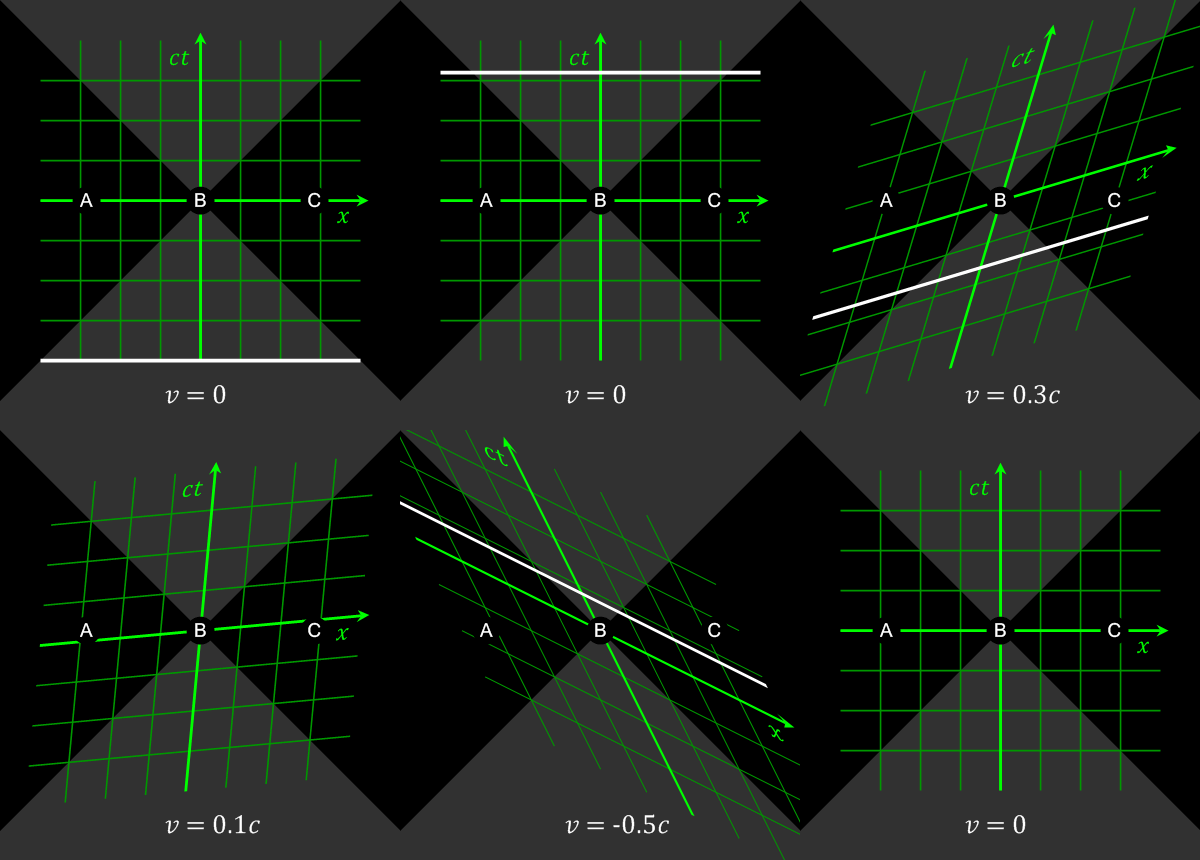
Because the spiritual world is made of light and exists at the speed of light, it exists outside of Earth-time. As a result, the Lord and his angels can see through all of time, because all of time is relative to them, rather than them to it.
In this light, the apparent paradox dissolves. People do not exist before they are born, but once born and entered into eternity, their relation to time changes entirely. What appears to us as the future becomes present to them insofar as the Lord allows it to be perceived. This does not require a literal collapse of causality, but a shift from temporal sequence to one of simultaneous order.
Modern physics may be pointing toward more than mere analogy. Einstein demonstrated that time and simultaneity are not absolute features of reality. Events that appear sequential in one frame of reference may be simultaneous in another, depending on the observer’s state of motion. This principle, known as the Relativity of Simultaneity, shows that temporal order itself is perspective-dependent rather than universally fixed. What appears as past, present, and future from one standpoint may collapse into a single ordered whole from another.
Experiential accounts echo this perception as well. Howard Storm, for example, described his near-death experience in these terms:
Time as we know it doesn’t exist. In this world, we live in what’s called linear time… In heaven, all time is there. When I was with Jesus, we went back in time, we went forward in time, we traveled through space to other worlds — with no transitional time. We would go across the universe to different places. We’d be here, and then we’d be there. There were different physics than what we know in this world.
—Howard Storm (video about the Heavenly Realm)
Such testimony resonates with Swedenborg’s description of a world ordered by state rather than duration.
If Swedenborg was permitted to enter such a state during his spiritual journeys, even temporarily, then his encounters with spirits from other worlds weren’t constrained by our linear timeline. He lacked the language of modern physics, computation, or information theory, yet the structure of what he described aligns with ideas that only later became conceptually accessible to science.
The word singularity literally means “conforming to one.” In that sense, it is not inappropriate as a metaphor for eternity, since the Lord is one, and all order converges in him. To think outside of linear time is not to abandon reason, but to extend it beyond appearances into the deeper structure of reality.
You may then wonder: what then happens to free will, does what you just said infer predestination?

As we touched on earlier from Swedenborg’s writings, there is no such thing as predestination. As he wrote, everyone is “predestined” for heaven — that is, set up by God with everything they need for success — and none for hell. However, you and I do have free will so long as we are still alive, “in time,” that is, while living out our mortal lives, and there are definitely people who wind up in hell. Every moment you are living, you are making your own decisions — but think of your life like a video tape that, once over, has been fully recorded. While it was being recorded, you truly made your own decisions. But, God, since he exists outside of time, always had the video tape and could always watch it unfold. The fact that he exists outside of time means that he could always see what you did. Swedenborg wrote that each person has a fixed place in heaven or hell into all of eternity, but even so, that doesn’t mean that God predetermined your decisions and location. You still made them and are making them, non-deterministically, even as you read this article. He simply always has the power to see them from his infinite vantage point.
When I was talking to angels about the Lord’s Divine Providence, spirits were also present who had convinced themselves of some idea about fate or absolute necessity. They imagined that such necessity determined how the Lord acted since he can proceed only with due regard for things that are utterly essential, that is, only by observing the requirements of utterly perfect order. But those spirits were shown that a person possesses freedom, and that if he possesses freedom what happens does not arise out of necessity.
A house that is going to be built was used to illustrate the point. The bricks, clay, sand, and stones serving as plinths and columns, also planks and beams, and many more such materials, are not gathered together in the order in which the house is constructed but in whatever way one pleases, the Lord alone knowing what the house will be like that is built from them. All the things one receives from the Lord are utterly essential; yet they do not follow one another in any necessary order but with special reference to the person’s freedom.
In case I’m bending your mind a little bit too much, let me try to unbend it just a little bit with some examples. If you haven’t seen the movie, Interstellar, I highly recommend it. It’s an excellent movie and will give you a strong conceptual understanding regarding what Swedenborg taught about time, space, and alien life. Many of the ideas within the movie brush up against the subjects we’re exploring; a narrative backdrop that will help you to understand some concepts surrounding how time unfolds.
As you watch this clip, remember what was said earlier, that within New Christian theology, love comes first and centers our understanding of the universe, from the inside out, rather than from the outside in.
In the video clip above, Cooper, (played by Matthew McConaughey), says:
All of this, every moment, is infinitely complex. They (the alien species) has access to infinite time and space, but they’re not bound by anything. If they can’t find a specific place in time, they can’t communicate.
Imagine Cooper as if he were an angel. As he looks through the bookcases, he can see his daughter in time, but he can’t directly interact with her. He has to find a way of communicating with people on Earth, one that doesn’t violate the timeline, nor their free will.
Swedenborg wrote that the reason that the Lord can’t appear to us in person “is that ever since he ascended into heaven, he has been in his glorified human manifestation. In this he cannot appear before any human beings unless he has first opened the eyes of their spirit… No one can see angels through physical eyes” (True Christianity #777).
In the movie, Cooper communicates using love as a method. This, too, is how Swedenborg said the Lord and his angels communicate with us, particularly those of the celestial heaven. “Love” being not merely a sentimentality, but a passion of the will for helping us and doing good. The Lord had to find a specific place in time from which to communicate — through which his impact for good would be the greatest — which as we know from his story, he did when he was born in the first century. His life and death created a ripple effect that spread throughout eternity, balancing the forces between heaven and hell so that we still had the ability to choose heaven.
Whenever he needs to communicate with us again, he is still able to, by opening up our spiritual senses. Often this is accomplished by prophets with a talent for writing, such as Swedenborg, who he grants the ability to see more deeply into the spirit world, using angels as messengers.
Cooper continues:

Don’t you get it yet… they’re not “beings.” They’re us. What I’ve been doing for my daughter, they’ve been doing for me, for all of us.
Every angel, Swedenborg said, once lived a mortal life, but now that they have entered the spirit world they’ve become immortal and thus live outside of our frame and reference of time. Some angels once lived on our planet, and others lived on other planets, but regardless, they live beyond our limitations of time, and the way they most often communicate with us through love is by a method that Swedenborg termed, correspondence.
Correspondence is sometimes mistaken for symbolism or coincidence, but Swedenborg uses the term in a more specific sense. It does not mean that events merely appear meaningful, but that natural forms are produced and sustained from spiritual causes according to fixed laws of order. Later thinkers such as Carl Jung observed psychological patterns, such as synchronicity, that echo this reality, but correspondence itself is not a human theory or interpretive tool. It is a divinely established structure by which spiritual life flows into the natural world.
Because creation is ordered from the spiritual world, human thoughts and affections are never isolated from heaven. Yet this conjunction does not bypass the Lord’s order or human freedom. Spiritual influence from heaven occurs through human affections that correspond to a person’s state of life, never through compulsion.

A tesseract, created digitally by Jorge Fernández.
Every moment is infinitely complex and interlinked with every other.
These experiences established the idea that we were created to live in heaven among the angels at the same time as we are living on the earth among people, and vice versa. If that happened, heaven and earth would come together and form a single whole. We would know what was going on in heaven, and angels would know what was going on in the world. When we died, we would then be crossing over from the Lord’s kingdom on earth to the Lord’s kingdom in the heavens. It would not be as though we were passing into a different kingdom but into the same one we inhabited while we were living in our body. Instead we have become so body-oriented that we have shut heaven off from ourselves.
Think for a minute, that if you were an angel, how exactly would you influence someone on earth without interfering with their free will?
Would you give them clues? Through dreams and symbols, perhaps?
Those clues would allow them to piece the solutions to their problems together as if on their own, if they wanted to, but not if they didn’t want to. With this technique, you’d give them the tools for success without compelling them.

Since we’re referencing a fictional movie, here, it may seem like this idea of spiritual correspondence with angels across dimensions is also fiction. The idea in the movie about gravity crossing dimensions may be fictional (or may not be), but the idea about love transcending and communicating across dimensions with angels isn’t.
“These things have been shown to you so that you can see creation on the scale of the universe reflected in these particular models. For God is love itself and wisdom itself, and his love contains infinite affections, and his wisdom infinite perceptions; all the things to be seen upon earth are correspondences of these affections and perceptions.”
“When people are governed by the good of love and faith, such correspondence exists with them. The Divine composes everything residing with them, for the Divine is the source of the good of love and the good of faith. All the miracles referred to in the Word were accomplished through correspondences. The Word has been written in such a way that all the details there, even the smallest, correspond to things in heaven. Consequently the Word has divine force; it links together heaven and earth. For when the Word is read on earth the angels in heaven are stirred by the holiness contained in the internal sense. This happens because of the correspondences that all the details possess there.”
The things that are good and true in these ideas themselves may allow you to communicate with angels as you contemplate the messages within it, as will any work of art inspired by truths in the Word, even if you are barely aware that its root influence is the Lord.
I think for most of us, if we stop and think for a minute, we can remember moments where something correspondential, or other-worldly, occurred to us. For example, something we were hoping or praying about, which came true, which was just a little bit too serendipitous to be written off as coincidental. Or a voice we heard, a dream we had, a thought that popped into our mind that saved a life or introduced us to a life-long friend, or help from a stranger at an opportune moment.
One of Swedenborg’s pivotal teachings is that the Lord Himself, who is infinitely God, was born in time. The Lord’s life was one perfect correspondence with heaven, which allowed heaven to be linked to earth once again. Because of this, New Christians don’t believe that there are three separate people in the Godhead, just one, and that the one God simply took on a human form in time, which didn’t mean that he divided himself into two or three people, but that he simply manifested himself in a new way.
I realize that many people will be saying to themselves, “How can anyone grasp something on a deeper level of rationality, something that has nothing to do with space and time? How can anyone grasp the notion that this not only exists but is the All, the very source of everything?” Think more deeply, though. Think whether love or any of its desires, whether wisdom or any of its perceptions, whether even your thought itself is in space and time, and you will discover that they are not. Given the fact that Divinity is love itself and wisdom itself, then, it follows that Divinity cannot be conceived of in space and time, so neither can the Infinite.

There are reasons why God typically doesn’t let spirits and angels talk to us directly except through dreams and correspondences and why they’re hidden behind a veil and can only communicate with us this way, reasons that Swedenborg lays out in Divine Providence, that have to do with spiritual development and protection against hell (Divine Providence #175). Life is like a stage, and these secrets are not revealed all at once because most people would reject or misuse them. The fact that you’re reading this may be evidence that you’ve opened your heart and mind up enough that the Lord is able to begin to reveal these truths to you (Secrets of Heaven #5006). If they’re not making sense to you yet, it’s important to study the Word and then return (True Christian Religion #208).
The movie, Arrival, is a fascinating story that also brilliantly depicts the concept of time we touched on earlier whereby the Lord’s providence doesn’t follow in order, and yet we nonetheless maintain free will. In the movie, Louise Banks (played by Amy Adams) meets with an alien species who live outside of Earth-time. They have a special form of writing that, once read, unlocks an ability within her spirit to understand their perception of time. She then realizes that time isn’t strictly linear, but fluid. Any one single decision may appear to be built upon the last, but in reality, and like Swedenborg said, it doesn’t follow in order. The alien writing works for her sort of like the Word works for us, embedding itself into her subconscious in a way beyond her direct perception at the moment but that only later becomes more clear to her.
I think we, as a human species, are starting to pick up on this ability, as we enter into a new age of enlightenment, which is why this theme is appearing more often within our movies.
We are allowed to see divine providence from behind but not face to face, and when we are in a spiritual state, not in a materialistic state.
About our Moon and about human willingness to think outside the box.
Spiritual speech is universal, from mental images, but its sound, or rather its articulation, flows from the affection itself which is natural to it, so that the affection expresses itself through sound, that is, it is articulated through those, just as every affection has a natural gesture along with it. Accordingly, the sound of their speech, that is to say their words, flows from the whole spirit. Mental images are born of the affections, which also are similarly formed in the spiritual body. But for the most part what spirits speak among themselves cannot be expressed in earthly language or speech, for it does not fall into words or into the sensory mental images of the thought that a person has when in a material body; when in the body they are of a general nature.
Of course, Arrival is a fictional story, but it’s eerie to see how similar it is to some of the things Swedenborg described in his writings. He wrote about spirits who “boom when they speak; sometimes they do this all together, like a column of troops… I have been told that these spirits correlate with the shield-shaped cartilage which is situated in front of the cavity of the chest and which serves as a support for the front of the ribs and also for various voice muscles” (Arcana Coelestia #5564). He described those spirits as short, humanoid, and from our Moon (Other Planets #111, Spiritual Experiences #3245), but of course, movie directors like to use imagery that is big and scary for a more solemn effect.
He wrote, “I somehow got the feeling they were from the Moon” (Spiritual Experiences #3244) and his use of “somehow” (Latin: quodammodo) indicates, perhaps, that he didn’t realize that they were from the future, because, unlike in Einstein’s era, the Theory of Relativity hadn’t been fully revealed to scientists. Swedenborg revealed the spiritual truth that heaven exists outside of time, governed instead by states of love and thought. Later, Einstein showed through relativity that time is not absolute even in the natural world — suggesting that reality, both natural and spiritual, may transcend our usual notions of time.
Although “belching” spirits on the Moon makes some people laugh when they read it, as it did for spirits observing it in the story — seeing and hearing similar ideas as this depicted with visual and auditory effects in movies like Arrival allows us to realize that such forms of life could exist, and that the idea is not as far-fetched as it may appear to be in written text. Given a unique atmosphere, different gravity, and different conditions of time and space, who is to say what is crazy and what isn’t?
Swedenborg wrote, “the thought occurred that they are not like others, because they do not have their kind of atmosphere; and what atmosphere they do have around them I do not know” — so he was very much aware that the Moon doesn’t have a normal, thick atmosphere, something that telescopes in the eighteenth century could clearly detect. And yet, he was nonetheless being honest with us about what he saw, no matter how bizarre it may have sounded. Although the Moon only has a very thin atmosphere right now, perhaps it will be terraformed with future technology to generate a denser one? And its future atmosphere wouldn’t need to consist of the exact same mixture of elements as Earth’s atmosphere. A thicker mix of heavier gaseous elements, such as argon, krypton, xenon, radon, and others, in addition to enough oxygen, may be better suited to it and allow it to hold to its gravity, for which humans from Earth who will colonize it and live in underground shelters will gradually adapt to over many generations of evolution.

Most people have experimented with inhaling helium from a balloon and then exhaling it, and how that makes their voice high-pitched. This is because helium is much lighter than nitrogen and oxygen, which is what you usually inhale. However, if you inhaled a gas that was heavier than nitrogen and oxygen, like krypton or xenon, and then spoke, your voice would sound lower. If these heavier gases would be more suitable to the Moon, and used there for its atmosphere in the future, it would make sense that the beings from there would have deeper, booming voices, even if they were shorter than us.
Swedenborg wrote that:
The inhabitants of the Moon do not speak from their lungs like the inhabitants of other planets, but from the abdomen and therefore from some air that is stored there. This is because the Moon is not surrounded by the same kind of atmosphere as other planets are.
While I was writing this section of this article, I often wondered why the Lord had Swedenborg include these details about other planets, specifically about the Moon, considering they can be so anti-faith affirming for anyone who isn’t able to piece it together; and I think that was exactly the reason. Only someone whose faith is anchored in a love and understanding deeper than these odd details, will be able to survive them, unscathed, thus protecting the unfaithful from committing profanation.
I also got the sense that we should treat the features of alien species that are different than ours with respect and not tease them about their differences. In the future, it will be evident that they are real, and that this is simply who they are, and to mock them for how God made them would be as cruel as it would be for us to denigrate somebody from Earth with a different skin color. After all, we’re all derived from the same Creator.
For the full account of people from the Moon, see Spiritual Experiences 3241 - 3245.
Swedenborg wrote about things beyond his time, using eighteenth century language.
This can sometimes make his meaning hard to grasp in modern English, even with the best translations; not because his ideas are unclear, but because he was describing realities and operations for which there wasn’t a settled Latin vocabulary and because many of the things he had to describe had not yet been invented, labeled, or widely understood. So as his Latin is parsed, the question that keeps having to be asked is, “what is the modern equivalent of what he was pointing to?”

An IP Address is a modern example of a form of writing that uses numbers. Every website has a number like this that it corresponds to.
For example, Swedenborg wrote that angels are shown “representations” in heaven that teach and illustrate the Word (Heaven and Hell #170). In modern terms, the closest equivalent is a moving visual presentation, a scene that unfolds before the senses in sequence and communicates meaning by images, motion, and arrangement. Today, the ordinary word for this would be a “film” or a “movie.” But no such term existed for him. The word available to him was repraesentativis (representations). The label is old, but the function of it is extremely recognizable when you start to think about it.
He also reports that angels write using numbers (Heaven and Hell #263), and then describes this numerical writing:
I have also seen written materials in heaven comprising nothing but numbers arranged in a pattern and series, just like the writing of letters and words; and I have been told that these writings come from the inmost heaven, whose heavenly writing (described above in 260-261) comes out as numbers for angels in the lower heavens when thought from the higher heaven flows down. I have also been told that this numerical writing enfolds mysteries, some of which cannot be grasped by thought or expressed in words. All numbers do in fact correspond and have meaning depending on their correspondence, just as words do, but with the difference that numbers represent general entities and words specific ones. Since one general entity involves countless specific ones, numeric writing enfolds more mysteries than alphabetic writing does.

Here, it appears Swedenborg was not giving a metaphor. He was describing a form of information that is encoded, structured, and compositional: numbers “arranged in a pattern and series,” representing “general entities” that contain “countless specific ones,” and that, when flowing down from a higher level, appear in a simpler form to those below. That is how modern computation works. Higher-level meaning is expressed through abstraction, structure, and hierarchy; and when it descends into execution, it is transformed into a form that produces visible outcomes. In computer science there are millions of variables, or “truths” that go into forming a virtual space, and at the lowest, most fundamental level, the science of virtual space is based on boolean logic, which means that every element of a computer program is composed of either a 1 or a 0, indicating something as either true or false.
In modern terms, “one general entity involving countless specific ones” is what software engineers handle constantly. A single definition, rule, type, or “object,” that organizes many specific behaviors. In everyday programming language, it is the difference between a general construct and its many instances, between a declared structure and the countless particulars it governs when it runs. What would have appeared like an incomprehensible angelic script to most people in the eighteenth century is now something ordinary programmers work with daily.
Swedenborg’s description of “thought from the higher heaven” flowing down and appearing as numbers in the lower heavens also matches a familiar modern pattern. As information moves from a higher level of structure to a lower level of execution, it becomes less like “speech” and more like “code.” The same thing occurs every time a program is compiled and run. Most of what actually governs the visible result remains hidden from the average user, and only the outward effect appears: images, text, and interactive experience. He described a similar relationship between higher and lower heavens, whereby deeper things are present within outer things, but the outer level is what is directly perceived. We may even go so far as to say that the variables in computer programs “correspond” to the images that are then produced, as they do in mathematical functions, each representing an underlying truth of reality.
Swedenborg then added a detail that makes this structure even clearer:
In this kind of writing in heaven the number on which the following numbers depend in sequence is always put first, as though it set their theme; for this number is a kind of title of the matter under consideration, and the numbers that follow serve to delimit the matter more specifically.

An example of hexadecimal code.
This concept is used extensively in computer science and is called a protocol or a header. The protocol defines the type of language format and logic that will be taking place and how to break up the sequences of numbers that follow into secure commands. (In fact, one was used when you loaded this website, called HTTPS, which, in the browser, has a numeric signifier behind it that delineates it from other protocols.)
This is a description of ordered encoding: a leading signifier that determines how what follows is to be interpreted, and a sequence thereafter that specifies details under that governing theme. In modern terms, this is how structured information works. A header or leading identifier determines the meaning of what follows. The content is not random; it is parsed according to the initiating marker that “sets the theme.”

An example of binary code.
This is not a niche concept in computing. It is the basis of communication and interpretation in all digital systems. When a browser loads a website, it does not receive one amorphous stream of data. It receives structured messages whose first elements specify what the message is, how it should be interpreted, and what rules govern what follows. In that respect, a web browser is really a kind of virtual world: a domain in which invisible logic is translated into visible experience through ordered layers, where inner structure becomes outer presentation.
The modern world supplies a striking illustration of this principle. Digital experience is built out of elemental distinctions: on and off, signal and no signal, difference and no difference. A screen produces an image through innumerable tiny states of activation. In itself, that is not spiritual truth, but it does provide a clear outward mirror of a deeper spiritual principle. Higher meaning can be carried by lower-level distinctions, and immense complexity can be encoded within simple foundations.
In the spiritual sense, truth and falsity are not zeros and ones. They are honesty and deceit, reality and distortion, alignment with the Lord and resistance to him. Yet, when spiritual order is expressed outwardly, it always reaches a plane where distinctions become simple and external. That is why Swedenborg can say that numbers correspond, and that in their correspondence they carry meaning. General things contain countless specifics. Inner things govern outer things. Higher things descend into lower things. And meaning is preserved through the descent because the Lord maintains order at every degree of life.
The deeper point is not that heaven is “a computer,” but rather that computers, as simulators of the universe, can function as a reflection of heavenly order, like the universe does. That ordered meaning can descend through degrees without losing its essence. Swedenborg’s doctrine of correspondences is precisely about this: spiritual realities are expressed in natural forms, and natural forms contain spiritual realities within them. The outward expression differs from the inward cause, but they remain singular, the way a living mind expresses itself through a living body.
This brings the point back to the Word itself. Just as our spirit is formed as the pattern of our volition and thought, so the Word is the pattern of the Lord’s Divine Human. When the Word is read with a genuine desire for truth and a life oriented toward repentance and charity, its inner structure is opened. The pattern emerges in the mind, not as an abstraction, but as something living and formative. In that moment, the Lord is present. For this reason, Swedenborg taught that the Word is not merely about the Lord, but is from him and is the means by which he is conjoined with us. He also described the spiritual world in ways that resemble what people now experience in virtual spaces: an environment where scenes can change swiftly, where location is governed by state, and where perception is shaped by intention. Modern virtual reality is an outward shadow of that idea. A person can be sitting still while moving through an entire world of artificial or “spiritual” experience. The more this technology advances, the less, too, that it feels artificial, and the more it begins to feel even more real than physical reality. The body remains in its same place, while the mind’s perception is carried elsewhere by an ordered system that translates invisible structure into visible reality. Swedenborg explained that the spiritual world operates by inner change, not by physical distance, and that its appearances are real as their degree of reality, because they are produced according to spiritual laws. The same mathematical principals underlying each layer, thus they aren’t truly “fake,” since they carry the same underpinnings.

What other realities did Swedenborg see that we do not yet have language for? What other forms of order exist beyond the conceptual reach of our present century? The question is not whether future inventions can “prove” heaven, but whether the Lord has already shown the outlines of the principles of heaven that will later become easier to visualize in natural terms. If so, then the limitations of human vocabulary are not any kind of evidence against Swedenborg’s testimony of the spiritual world, only of the distance between what heaven is, and what the knowledge of past eras was able to distinctly label.
And if time itself is less solid than it seems, and if simultaneity depends on perspective, than the intelligence of the human race may only now be beginning to learn how to think outside of the assumptions of linear sequence. The deeper order of creation is not a straight line at all. It’s a unity that appears sequential only within the boundaries of natural perception, while in itself it remains a single, coherent whole, held together by the One who is eternal.
Divine Substance and Reality
By Swedenborg:
Everyone who thinks in the light of clear reason sees that the universe was not created out of nothing, since he sees that something cannot be produced from nothing. For nothing is nothing, and to make something out of nothing is self-contradictory. Furthermore, anything that is self-contradictory is contrary to the light of truth that emanates from Divine wisdom, and whatever does not accord with Divine wisdom also does not accord with the Divine omnipotence.
Everyone who thinks in the light of clear reason also sees that all created things have been created from a substance which is substance in itself, for this is being itself, from which can spring all things that are. Consequently, because God alone is substance in itself, and so being itself, it follows that the origin of things is from no other source.
Many people have seen this, because reason grants them to see it. But they have not dared to assert it, fearing that if they did so they might perhaps end up thinking that the created universe, being from God, is God, or that nature exists from itself, and thus that its inmost component is what we call God. As a result, even though many have seen that the origin of all things is from no other source than God and His being, still they have not dared to venture beyond their first thought concerning it, lest they entangle their understanding in a so-called Gordian knot from which they would afterward be unable to extricate it.

They would be unable to extricate their understanding for the reason that they have thought of God and about the creation of the universe by God in terms of time and space, which are properties of nature, and no one can comprehend God and the creation of the universe from the perspective of nature. On the other hand, everyone whose understanding possesses some inner light can comprehend nature and its creation from the perspective of God, because God does not exist in time and space.
In subsequent discussions we will see that although God created the universe and all its constituents out of Himself, still there is not the least particle in the created universe that is God.
Swedenborg wrote that God is not bound by time, and exists outside of it. In some respects, this idea aligns with the most widely accepted theory of the Big Bang, which is that space and time came into existence only after the Big Bang occurred:
Before the creation of the world space and time did not exist in God or in His presence, but they did after this event.
That said, a problem with the Big Bang Theory is that scientists have conceptualized it as a dense point of mass that existed at the beginning of the universe — the one that they think exploded and kicked off the universe’s expansion — and that it existed as a singularity of physical matter. And they think of it as if this “thing” — whatever it was — was just a phenomenon of nature. However, this idea is deeply flawed. They may have some of the math correct, but they have the wrong theory, and they know it, as they relentlessly pursue a Theory of Everything to explain the math they can’t explain. What they don’t know, or otherwise choose to dismiss, is that the Theory of Everything is the Lord and that he is found in the Word rather than in nature.
By Swedenborg:
It is acknowledged by many that there is an only substance and that this is also called the first substance [the cosmological singularity], the source of all things; but the nature of this substance is not known. It is believed to be so simple that there is nothing simpler; that it may be compared to a point with no dimension; and that from an infinite number of such points the forms of dimension came into being. This, however, is a fallacy, originating from the idea of space; for in accordance with this idea, there would appear to exist such an object of this minimum size. Nevertheless, the truth is that the simpler and purer a thing is, the more complex it is and the more it contains. For this reason the more interiorly any object is examined the more wonderful, perfect and beautiful are the things seen in it; and thus in the first substance are the most wonderful, perfect and beautiful of all.

The Lord meets with a woman within the Heavenly Sun, from the documentary, After Death, by Angel Studios.
This is because the first substance is from the spiritual Sun, which, as has been said, is from the Lord, and in which the Lord is. Therefore that Sun is itself the one only substance; and as this Sun is not in space it is the all in all, and is in the greatest as well as in the least things of the created universe.
If we think it’s probable that a wide variety of life forms exist in the universe — as most scientists do — couldn’t there be one infinite living form, such as the Lord says he has, and who forms us spiritually within him?
Wouldn’t he then be life itself, having created it, rather than it having created him?
As Swedenborg wrote, the material universe is not God, but it is a reflection of him.
Then too, there are people who claim to believe in an invisible Divine called the “Being of the Universe” and reject any faith in the Lord. When they are examined, it turns out that they do not believe in any god at all, since this invisible Divine of theirs is actually like the first principles of nature. This is incompatible with faith and love, because it eludes actual thought. These people are banished to the company of those called materialists.
He makes clear that the Lord is not the Heavenly Sun, but that rather, it is an emanation from him, that represents him:
That sun is not God, but it is an emanation from the Divine love and wisdom of the human God. So, too, the heat and light from that sun. In referring to that sun, visible to angels, from which they have their heat and light, we do not mean the Lord, but we mean the first emanation from Him, which is spiritual heat in its highest degree. Spiritual heat in its highest degree is spiritual fire, which is Divine love and wisdom in their first correspondent form.
After all, if we, on earth, can create virtual spaces (aka “spiritual” spaces, by analogy) using computer technology, how come it’s such a huge leap in reasoning to believe that the Lord can’t — or already hasn’t — done the same thing and called it heaven and hell?
The video, below, shows a digital rendering of an environment created entirely within a computer using software called Unreal Engine, which is used for creating cutting edge computer games and movies. If I hadn’t told you, would you have guessed that it was a virtual environment created in a computer and not real footage of a forest? (Look closely at the water droplets, in particular, and you can just barely tell.)
What is reality anyway other than an idea?
The truth or verity, as Swedenborg wrote about, is a concept, or a cognition, not merely an item of material matter. What is the underlying truth of a rock or a tree? That truth exists inside of you, in your mind, in your idea of it, not necessarily in the rock or tree itself.
If people have no concept of heaven and do not want any concept of it other than one of some insubstantial atmosphere in which angels fly around like intellectual minds without the senses of hearing and sight, they cannot believe that angels have language and writing. They locate the entire presence of everything in matter. Yet the things that one finds in heaven occur with just as much reality as those in our world, and the angels who are there have everything they need for life, and everything they need for wisdom.
In just a year or so from when this article is published, these graphics will seem rudimentary, as more powerful graphics processing chips, processing techniques, and artificially intelligent algorithms will emerge. This has been the trajectory of human progress over the last few decades, referred to as Moore’s Law. Human technological capability has exploded in and sophistication on an exponential scale.

Most people know about virtual reality today, but how many people have actually linked it in their minds to the concept of the spiritual world that the ancients wrote about? When we die, who’s to say that we won’t enter a realm just like this, albeit with far better graphics that are yet to be invented hundreds or thousands of years from now?
About time in heaven being a matter of state rather than of predictable motion, in computer science, and in physics, there is a similar concept called A State Machine, which can be mimicked in video games and virtual reality. Virtual worlds are often built as a series of objects, which can be acted upon, created, or destroyed at will, rather than merely as a set of constants. Within digital spaces, the laws of physics can be rewritten and manipulated however you please, and its interesting to contemplate how that may correspond with how Swedenborg describes such spaces being instantaneously crafted within the afterlife. In a virtual space, for example, gravity is no object, nor is time and space. If you want to go somewhere, you simply go there. Like in a computer program, you’re only limited by your own wishes. If you want to change day to night or night to day, you can do that in an instant. And, although you can manipulate your environment however you please within virtual reality, you still bring your personality with you. Those who love others, continue to love others, and those who hate others, continue to hate them. For this reason, you can imagine that in a future where everybody enters into the Matrix, so to speak, mankind would naturally create their own iterations of heaven and hell, their own governments, laws, and communities, just as they do within virtual spaces today, and that you will bring with you your essential, internal nature, whether good or evil. Swedenborg wrote exactly this, that in the afterlife, people take with them the character they formed during their mortal life.
Spirits have exactly the same affections and inclinations as they had when they lived as human beings in this world. For everyone’s life accompanies him. This being so, it is possible to know the character of the people of any world by reference to the spirits from it.
Every piece of who they were — particularly their will — remains intact to eternity.
In NDE stories, many people describe the spiritual world as seeming even more real than our physical world. It’s as if they’re describing a world where their eyes have been upgraded to see more colors and more pixels than our eyes can perceive, which is possible, perhaps, because they’ve been transported into virtual reality, where the laws of physics, and its interactions with the human mind, can be tweaked and modified for an even better sensual experience, beyond what we can even imagine today. Swedenborg called it “substance” or “real substance” (Divine Love and Wisdom #42). How else would he describe it? So long as you experience it in your mind or “spirit,” it’s real to you.
Base Reality Is Spiritual, and The Fermi Paradox
The author of the blog, Wait But Why, did an interesting article about The Fermi Paradox, which explores this question: why, with all of the planets in the universe, have humans from Earth never heard from alien species? Although he posits several possibilities, one possibility may simply be that we are the first species to evolve on the most outward, or most physical, plane of existence, and that the rest of the species in the cosmos evolved, or will evolve, in or near to something analogous to the spiritual world, such as what Swedenborg wrote about. To quote Elon Musk, “The odds that we are in base reality is one in billions” — meaning, the odds are extremely high that we are a subset of another reality. Perhaps “the spirit world” will be something that mankind iterates on, and that we will then inhabit that reality rather than the actual planets in the cosmos. We would send probes and robots to the planets to map them out and send us back the data, but without actually needing to step foot on them, just as we’ve already begun doing with Mars rovers and helicopters. We won’t need spacesuits to visit all of them, and although we will want to physically visit them anyway, most of us may choose, for the most part, to travel and live there in virtual reality.
One explanation, which Swedenborg himself wrote, is that the planets that he described are different than our physical planets. That is, our planets were like spiritual copies of theirs, or vice versa, and perhaps people in the spirit world simply gave them the same names as our physical planets, such as Mars, Jupiter, etc, because something about them corresponds with our planets and with reality in the physical realm.
While describing the inner meaning of the Book of Revelation, Swedenborg wrote:
“From whose face the earth and the heaven fled away” signifies that those heavens, which they had made for themselves, as described above, together with their planets, were dissipated; for there are planets in the spiritual world as well as in the natural world… but the planets, like all other things there, are from a spiritual origin.
If we are to assume that the Lord exists and is divine, and that he is omnipresent and exists outside of space and time, then we can safely assume that an afterlife exists, and thus a spiritual world. And if one spiritual world exists, such as the one corresponding to our Earth, then why not many others as well, corresponding to Mars, the Moon, Jupiter, Saturn, and the rest? Why not the whole universe, and many versions of it? Scientists have even coined terms such as the multiverse to describe models in which our universe is not the only one. Some physicists have also proposed that what we call the physical universe may rest upon deeper structures that are not directly accessible to our senses, which aligns with the idea that natural reality is only the outermost layer of creation.
We also know that in the world of quantum physics, natural phenomena behave very differently from what they appear to be in classical physics, and that much remains to be learned which may shed light on the existence of a spiritual world.
Swedenborg perceived that there was a reality beyond what could be seen and measured with human instruments.
From Arcana Coelestia #4224:
Organic forms consist not merely in those which are visible to the eye or which can be discovered by means of microscopes. Still purer organic forms exist which cannot possibly be discovered by any naked eye or any artificial device.

In quantum physics, an electron does not occupy one fixed location, but exists as a spread-out probability field around its nucleus until it is observed. Long before this was demonstrated, Swedenborg taught that there are substances and organic forms “which cannot possibly be discovered by any naked eye or any artificial device,” pointing to realities deeper than anything natural instruments can reach.
One might think he was referring to human cells, or even the molecules within those cells, since molecules were invisible to eighteenth century science. But he was not referring to cells, and could not have been, because cells were visible under the microscopes of his day, and because he said he was speaking of forms that no artificial device could ever disclose. Modern physics still encounters such limits. At the quantum scale, the precise position and momentum of an electron cannot be simultaneously known with unlimited accuracy. This is the Heisenberg Uncertainty Principle, discovered by Werner Karl Heisenberg in 1927. It describes a boundary built into nature itself, one that no refinement of instruments can surpass. Even the most advanced quantum technologies operate by working with observable quantum behaviors rather than by revealing a definitive classical picture of electron states. Swedenborg had no way of establishing this empirically, yet he reached the conclusion demonstratively, with revelation, reasoning, and mathematical reflection.
Before the eye or any detector receives it, light behaves according to principles worked out by scientists such as Niels Bohr, Max Born, Erwin Schrödinger, as well as Heisenberg, who showed that quantum systems remain in probabilistic states until an observation gives them definite form.
We also now know that light itself behaves differently depending on how and when it is observed. Before the eye receives it, or before any detector measures it, light exists in a state described by probabilities rather than a single fixed form. Only when it interacts with an organic receiver, such as the retina, is that potentiality resolved into a discrete outcome that the brain interprets as shape, color, and meaning. In other words, the act of perception participates in determining what is finally registered as a visible form, while the underlying state remains indeterminate beforehand.
These purer forms are more internal, such as the forms which belong to internal sight, and which in the end belong to the understanding. These are unsearchable, but are nevertheless forms, that is, substances, since no sight, not even intellectual sight, is possible except that which exists from something beyond itself. This is also well known in the learned world, that is to say, the point that without substance which is the subject, no mode, nor any modification, nor any quality which manifests itself in an active manner is possible.
This is not a mystical claim but a straightforward result of quantum theory, and it reveals something important for Swedenborg’s point. If even natural light waits for an organic form to give it definite expression, then interior forms that govern understanding and affection would be even further beyond the reach of external instruments. They operate at levels where natural measurement does not apply, and where the correspondence between the spiritual and natural must be discerned rather than detected.
Those purer or more internal forms which are unsearchable are those which give rise to man’s internal senses, as well as producing his interior affections. And these are the forms to which the interior heavens correspond since the interior heavens correspond to those internal senses and interior affections.
With this in view, the hard limits the Lord has placed upon our exploration of nature should not close our minds, but open them. If the very structure of physics contains boundaries that no instruments can cross, we can acknowledge that such limits exist for a reason. They remind us that he stands beyond what he has permitted us to reach by way of scientific inquiry alone, and that the reality he has veiled from natural sight may be greater than we assume. Recognizing these limits can help us remain open to the fact that a spiritual world exists, held in order by the same God who set natural boundaries in place.
Why Many of the Communities Swedenborg Described Lived Simply
In Howard Storm’s retelling of his near death experience, he said that the Lord showed him what the Earth would be like in a couple hundred years, or around the year 2185 AD. In that time, under an ideal scenario, humans will live in harmony with nature, such that it won’t appear that we live with technology, even though we may have far greater technology. If humanity is aligned with the Lord at that time, it’s very possible that this form of simple living will exist on other planets that we’ve populated, which could explain how it was that Swedenborg saw people in the spirit world (a world outside of time) living in what appeared to be simple surroundings.
On most of the planets Swedenborg visited, he described the people as living a relatively simple lifestyle. This is because they were living in the Lord’s order, and selflessly. People in a selfless state of life aren’t as motivated for constant expansion, domination — and thus, technological progress — as are self-serving people like us on Earth.
Historically, most technological advancements on Earth were accelerated during periods of conflict, where inventions were driven by the need to gain advantage over others. The Moon landings of the 1960s and 70s, for example, may never have occurred without the tensions of the Cold War, which acted as a catalyst for rapid scientific progress. Likewise, the work of figures such as Einstein and Oppenheimer, and the emergence of nuclear energy, arose within the intense pressures of World War II. In this sense, technological acceleration is frequently tied to states of human pressure and rivalry rather than to states of peaceful contentment.
This isn’t always the case, of course. People motivated by genuine concern for the common good have contributed many important advances in science and technology, but it’s not as common. Among them, such progress tends to unfold gradually and without the same urgency that competition and fear produce. Communities who are more altruistic and ordered in their desires often remain content with simpler, more rural modes of life, focusing their energy on family, charity, and harmony rather than on innovation, domination, and constant expansion.
However, even though the selfish state of mankind has been the condition of most of humanity’s recorded history for several thousand years now, the Lord has been able to use the advancements that came out of it for good, and will continue to do so. As Swedenborg wrote, the Lord ensures that everything, even what is created from evil, he bends towards a useful and good purpose, so that it benefits humanity for the better in the end, even if many of the people who invented advanced things, driven by their love of self, wind up in hell. This explains how the Greek and Roman Empires, although very corrupt on the whole, led to a lot of important human advancements in science, literature, and architecture. The same with Spain, France, and Great Britain, during their expansion and conquests around the globe. And the same is likely true of the United States today.
Why the Lord No Longer Teaches by Miracles
From Swedenborg’s writings, it appears to me that he grasped principles that later became formalized as the Theory of Relativity, and of the Theory of Evolution, and how their corresponding truths fit within the Lord’s creative process. But, he was just reporting what he saw and communicating it to us the best that he could, given the scientific knowledge he was acquainted with from his day. It’s also possible that he knew more than that, but, as he himself says, he wasn’t permitted to disclosed certain things because the world wasn’t quite ready for all of it yet. (For example, in his notes he’d write things like, “See whether it will be allowed to insert the above when the time comes for printing” Spiritual Experiences-Word Explained #5.) Likely, the reasoning is because the world needed to discover certain things as if on its own.
This is usually the way the Lord operates; rather than simply handing humanity things, he wants us to do some of our own searching, work, and discovery process so that when he reveals it to us, it was done seemingly as if on our own.
For example, Swedenborg wrote about six solar planets, which were the planets in the solar system known in his day: Mercury, Venus, Earth, Mars, Jupiter, and Saturn. This doesn’t necessarily infer that he didn’t know about Uranus, Neptune, and Pluto from his spiritual experiences — I think it’s possible that he may have — but either way, he wasn’t allowed to talk about them yet. Why? Because if he did, then scientists would later have evidence (or something closer to it) that he had this knowledge from heaven, and this would be perceived as a miracle rather than a point of faith. Why is that a problem? Well, as Swedenborg wrote about in his books, after the Lord’s resurrection, miracles began to cease because nobody was being reformed by them; they were doing more harm than good. When people see miracles, they tend to believe because of the miracle itself rather than because of love and wisdom inherently evident in the Gospels. As a result, because they don’t love the essence of the Lord as he appears in the Word, they lose faith, and discount miracles as mere coincidences, forget about them, or make up some other excuse or justification for them. The Lord wants people’s beliefs to be motivated by heavenly love, not by empirical evidence alone. Empirical evidence is not a function of love, it’s simply a function of physics. When people believe because of a miracle, their faith isn’t rooted, and nothing of persistent value is generated within them. Whatever confidence they obtained quickly fades away because it wasn’t anchored in love for the Lord.
I believe this is why, in quantum physics, there are strange things that occur which our scientists are not yet able to completely comprehend, such as the odd phenomenons observed — or not observed — with the Double Slit Experiment. It almost feels to me like the Lord is deliberately hiding deeper truths from us, precisely because of the above reasoning. Perhaps some of the mysteries of quantum physics will soon be revealed, but I imagine, only once the world has spiritually matured further than it currently has, so that such revelations do more good than harm to our inner lives.
This Church is not instituted and established through miracles, but through the revelation of the spiritual sense [of the Word], and through the introduction of my spirit, and at the same time of my body, into the spiritual world, so that I might there know what heaven and hell are, and that I might imbibe from the Lord immediately in light the truths of faith, whereby man is led to eternal life.
—An Invitation to the New Church #0
The question is asked today why miracles do not happen as they once did; for people think that if they took place, everyone would acknowledge them in his heart. The reason why miracles do not take place at the present time as they did formerly is that they compel and take away free will in spiritual matters, turning a person from a spiritual man into a natural one. Everyone in the Christian world since the Lord’s coming has been able to become spiritual; and the only way to be made spiritual is by Him through the Word, and the ability to undergo this would be destroyed, if he were brought to believe by means of miracles. As I said before, they compel and take away his free will in spiritual matters; and everything in such matters done under compulsion lodges in the natural man, shutting off the spiritual man as if with a door. It is the spiritual who is the real internal man, and this deprives him of all power to see any truth in light. After this, therefore, his reasoning about spiritual matters comes solely from the natural man, who sees everything which is truly spiritual back to front.
The reason, however, why before the Lord’s coming miracles took place was that at that time the people in the church were natural men, to whom spiritual matters to do with the internal church could not be disclosed. For if they had been, they would have profaned them. All their worship, therefore, was confined to ritual acts, which represented and symbolised the internal matters of the church; and these people could only be induced to carry out the rituals properly by means of miracles. Because these representative acts had a spiritual internal, not even miracles could at times induce them to carry them out, as is plain from the Children of Israel in the desert, who, despite seeing so many miracles in Egypt and then the greatest one on Mount Sinai, still after Moses had been absent for a month danced around the golden calf, crying out that it had brought them out of Egypt. They behaved in much the same way in the land of Canaan despite seeing the outstanding miracles performed by Elijah and Elisha and in due course the truly Divine miracles performed by the Lord.
The main reason why miracles do not happen at the present time is that the church has taken away all free will from people. It has done so by decreeing that man can make no contribution to the reception of faith, nor to his conversion or his salvation as a whole (see above, 464). Anyone who believes this becomes more and more natural; and the natural man, as I said before, looks at everything spiritual back to front, so that in thought he opposes it. The higher region of the human mind, the chief seat of free will in spiritual matters, would then be shut off. Spiritual ideas, which would have received a sort of confirmation by the miracles, would occupy the lower or purely natural region of the mind, while false ideas about faith, conversion and salvation stayed on top. This would make satans live above and angels below, like vultures living over hens. Then a little while later the satans would burst the bolts and rush furiously on the spiritual ideas occupying the lower position, not only denying them, but cursing and profaning them. So the person's last state would be much worse than his former one.
Evolution Within Divine Order

Because I am unable to form a picture of people other than those who live on planets surrounded by an atmosphere, therefore, although this is unknown to me because I cannot imagine it, I do not want to reject it out of hand. For bodily shapes are entirely according to the condition of the atmospheres and many other circumstances on the planets where they are.
These considerations also show that before the organic forms of the body came into being, their purpose existed, and that this purpose brought those forms into being and adapted them to itself, rather than the other way around. Once the forms have been produced, or the organs have been adapted, useful activity comes out of them. From then on, it looks as though the forms or organs precede their purpose, but they do not. The purpose originates in the Lord and flows in through heaven. In doing so it adheres to the pattern and form in which the Lord organized heaven, so it adheres to correspondences. That is how we come into being and that is how we survive. Again you can see why it is that the human being corresponds to the heavens in each and every detail.

This shows that he understood the metaphysical structure that later evolutionary theory would describe in natural terms, even though Charles Darwin hadn’t been born until about three decades after Swedenborg’s death, and the Origin of Species wasn’t published until 110 years after Swedenborg wrote these words in Acana Coelestia. Although many Christians deny the science of evolution and natural selection, and take a literalistic interpretation of the creation story in Genesis, this was not Swedenborg’s approach or understanding of it, because he was shown from heaven that their literal interpretation of it was false (Secrets of Heaven #1020, Secrets of Heaven #66).
By Swedenborg:
When people’s thinking does not extend beyond the sense of the letter they cannot do other than suppose that the creation described in the first and second chapters of Genesis is the creation of the universe, and that there were six days within which heaven, earth, the sea, and all that is in them were created, and at length the human being in God’s likeness. Yet is there anyone pondering on the details who fails to see that the creation of the universe is not what is meant there? For there are things in those chapters which common sense tells anyone are not literally true, for example, that days existed before the sun and moon, that light and darkness did so, and that plants and trees sprang up, when in fact it is through those [great] lights that light is given, light and darkness are divided, and so days come into being.
He wrote that the first eleven chapters of Genesis are entirely allegorical; that it’s a story about the creation of the human mind and spirit, the inner man, not a story about the creation of the outer universe. Genesis, and the Word by and large, is a spiritual, not scientific, book. He wrote that after chapter 11 of Genesis, the events and miracles described in the Word did actually take place and are historical fact, but even so, it’s the spiritual and celestial love and wisdom within the words themselves where the true value lies, not within the literal historicity (Secrets of Heaven #1410).
One can think what they will about whether the literal sense of the Word took place, but it doesn’t change the value of its inner sense.

With that said, Swedenborg was careful to emphasize that all life, matter, and existence derive first from the spiritual world, from the Lord, and from his creative power, not from nature acting independently. Charles Darwin, while largely correct in describing the natural mechanisms of human evolution, focused almost entirely on observable processes and did not extend his theory into the spiritual origins or purposes that stand behind them. Although Darwin did not entirely exclude the possibility of a Creator setting natural laws in motion, his theory of natural selection deliberately refrained from addressing divine providence, and his personal views became increasingly agnostic over time. This omission is one reason many Christians have felt threatened by evolutionary theory. Yet Darwin was not wrong. He described how natural development proceeds, not why it exists or from where it ultimately derives. When understood within a spiritual framework, these ideas are not in conflict. The Lord operates through natural forces, mathematics, and physical laws at the outermost level of creation, even as all such forces themselves originate from him.
The key difference between Swedenborg and Creationists, is that Creationists tend to imagine that God did something as simple as snapping his fingers and that then a man stood up out of the mud, as if his entire form was created in an instant. In reality, it took millions of years for God to form man, but man didn’t become truly “human” — the spiritual way we’ve described it — until he had reached a point within the divine design whereby he was able to act as a vessel of divine love and wisdom. The transition between when man changed from an ape to an enlightened human may have happened in something as simple as a mere instant of spiritual inspiration, when the first man became aware of God — the first spark of divine light in his mind — thus marking the point in human evolution whereby the human form became complete, that is, fully in alignment with the form of heaven. If you were to travel back in time and observe that moment, you may have seen nothing more than a person standing in a field, looking up at the sky, who had a mere thought, because the shift or evolution described in Genesis was spiritual, whereas the physical shift is forever ongoing. From that point, onward, humans have and will continue to evolve and continue to change in ways, perhaps, that we can’t fully anticipate, but not so completely as to verge away from the heavenly purpose.
Never Tell Me the Odds!
There’s a reason Han Solo’s instinctive response is “Never tell me the odds.” When questions of meaning are reduced to probability alone, the most important dimensions of purpose are often missed.
With that in mind, I want to return to the theory that the Earth may be the first planet in the universe capable of sustaining intelligent life technologically advanced enough to spread into other worlds. Although what follows is partly conjectural, it offers the most coherent solution I have found to the paradox of why the Lord chose to be born here instead of on another planet, with as vast as the universe is.
Points for this theory:
Perhaps the Lord wanted to seed just one planet for this purpose to start with, so that he could introduce himself into it, and thus introduce the Word into it, before it spread out into the universe. Swedenborg mentions this is true with regard the Word. Where my speculation comes in, is with regard to humans from Earth colonizing other planets (outside of our solar system), but to me, it makes sense that the Lord would wait to seed life on other planets, derived from one species, until that species first developed in maturity and until he was confident that they’d worked through their most serious problems.
There are many reasons, as I was informed from heaven, why the Lord was pleased to be born and take on human nature in our world and not in another. THE CHIEF CAUSE was for the sake of the Word, which could thus be written in our world; and having been written, could be circulated throughout the world; and once circulated, could be preserved for all posterity, thus enabling it to be made plain that God became man, even to all in the next life.
That makes sense with respect to his reasons for being born here as a human, and in a human genetic form, if he knew the human genome would spread across the universe and become the most populous, and would continually evolve from here, giving the inhabitants of future worlds a common genomic ancestor.
The Word, once written, could be preserved for all posterity, that is, for thousands and thousands of years. As is well known, it has been so preserved.
There was a conversation about why the Lord was born on this earth and not on some other, [and it was said] that the reason was that the doctrine made known from heaven could be spread abroad through the whole world and remain for thousands of years. This is because on this earth since ancient times such things have been entrusted to writing and after this to type, and it is possible to spread these abroad through the whole globe and for them to remain. This is possible because there are such forms of communication and permanence on this earth and not elsewhere. Elsewhere, the inhabitants are divided into tribes, families, and households, and do not know how to put the things that they know into writing, nor how to share them with others. Besides this, it is also the case that when the heavenly doctrine about the Lord is known on one earth, the rest can know about it when they become spirits and angels.

The Earth’s recent progress in computer science only adds greater evidence towards the validity of what Swedenborg said with regard to the Lord’s purpose for being born here, so the Word would be preserved through type, because now it’s being done digitally, in addition to on paper.
This solves the problem of squaring with the Word the improbability that out of all of the planets in the universe, he chose to be born on ours and not on another. So, a part of that solution is to take these two concepts: 1) that the Word was written for all posterity and 2) that the Word was designed to be shared with all other worlds, and link the two into the conclusion that we are the most technologically advanced world in the universe. As Swedenborg said, other planets don’t have writing technology.
In this way it could become clear that God had become a human. This is the first and foremost purpose of the Word, since no one can believe in a God and love a God who is incomprehensible because he has no specific manifestation. This is why people who worship God as an invisible and therefore incomprehensible entity lapse into thinking of nature as God and consequently believe in no God at all. For this reason it pleased the Lord to be born here and to make this fact clear by means of the Word — so that it might not only be known on this globe but could also become clear as a result even to spirits and angels who have come from other planets, as well as to non-Christians who have come from our own.
And, although it may still seem unlikely that Earth is the only planet with advanced writing and technology currently on it, the Fermi Paradox may act as evidence for it, since, so far, our scientists haven’t detected any other signs of life in the universe other than on Earth. We haven’t detected any radio signals likely because on the outermost level of creation — in our temporal field on Earth — technologically advanced aliens don’t exist (even if they exists in other planes of time outside of our temporal sphere).
This would also explain why it is that Swedenborg often alluded to our planet being the least spiritually mature planet, since, if it’s the root planet, it’s also one of youngest, since all future generations that stem from it will learn from our errors, thus becoming much more wise. This may indicate how it turns out that they end up living their lives in states of being that are more spiritual than ours, since they’ll have tapped into digital technology that more closely imitates a spiritual world, as well as love and wisdom, which would allow for a spiritual existence to be opened to them — perhaps to such a degree that they’ve replace our conception of time with theirs.
Swedenborg wrote about what’s called the Grand Man (Maximus Homo), the universal human form of heaven, in which all angelic societies are arranged like the organs and members of a single body, with the Lord as its soul and life. This form is mirrored within a regenerate inner person, whose will, understanding, and actions are set in heavenly order and extends by correspondence to the physical universe, since every inhabited planet produces a human race that fills a distinct place and use in the Grand Man, making the cosmos like an outer garment of heaven’s living order.

Radio telescope arrays, scanning for indications of alien life, have found no radio signals indicating it. So if aliens are out there, they may not be advanced enough to have developed either writing or digital technology yet.
With the Grand Man in mind, what I said above may seem to present a problem, because if other species in the universe evolved on a path that is separate from that of humans on Earth, then they would have parts and organs which may not correspond to ours, thus, how could they correspond with the Grand Man, which is modeled after the Lord’s human form? An answer for that is this: if all of them branched off of the human genome, even if they evolved over time to look differently than us, they would nonetheless correlate with the human qualities that developed on Earth, the human form which the Lord inhabited, the Lord’s human form being a likeness that corresponds with the vine from which every branch stems (John 15:5).
It makes sense to me that the Lord would only want to be born into corporeal form once, otherwise it would break several patterns of his design for human life and could result in people worshiping multiple gods (Last Judgement #21). That said, there is nothing stopping him from adapting his appearance in various ways to different people, which I believe he does (and which I wrote about in my article “Not God the fathers, God, Father”), but that he only lived one mortal life, which he then made immortal, having been resurrected into the substantial form of a body. And, if he chose to be born only once, it may as well have been near the beginning of the physical universe, on our world, if he foresaw that humanity on Earth would become the root of all future species that would later colonize and evolve on other uninhabited worlds.
This solves the question of why the Lord was born here, and the odds of it, but not necessarily why you and I were.
Current estimates are that there are two hundred sextillion planets in the universe. Written out, it looks like 200,000,000,000,000,000,000,000 — don’t stare too hard at it, just know it’s a big number.
Out of that gigantic number of planets, you and I just happened to be born on the root planet? The odds seem astronomical. How in the world is it the case that we, on Earth, happen to have been born on the same root planet that the Lord was born onto?
Thinking through this puzzle, I realized that, as was mentioned earlier, there are almost certainly many iterations of reality, and that we are not in base reality. Given the concept of multiple universes in different dimensions, one could postulate that the Lord built this specific universe for us to explore and inhabit. Thus, the two hundred sextillion planets that exist, or more, may well have all been created specifically for us. In other universes, other planets may have been formed for those species under their own unique circumstances and variations of physics.
That still left a sharp gap in reasoning; it still felt improbable. The only way I finally made sense of it was by thinking about how exponentials work relative to each other. Although I was born on the root planet, I was still born several billions of years after the creation of the universe, and several thousands of years after the introduction of the Word. And I live among billions of others on Earth, on a separate continent and country than the Lord was born, and on the other side of the planet. So, although it’s improbable on the scale so many planets, somebody still had to fill the role, and it just happened to be us who are presently here. For either one of us, or for somebody who has yet to be born, life had to be improbable before it could become probable. Just the same, imagine a person who is born billions of years from now, when many of those planets have been colonized. At that point, an enormous number of additional planets will have been discovered with an even greater number of zeros tacked onto their estimates, making the odds that that person was born on their planet relative to the many others seem similarly as unlikely as it is that you and I were born on Earth. The great question of faith for them may then end up being: what are the odds that the Lord was born in our corner of the universe rather than another corner?
No ratio exists between what is finite and what is infinite.
As you keep zooming in on the graph, the graph simply just gets larger, and the improbability remains. On an infinite scale, everything and anything that comes into form could appear to be just as improbable to exist as anything else does.
You can obtain some idea of this by looking at the animations for the Mandelbrot Set:
Swedenborg wrote:
There are very many proofs that the reproduction of the human race will continue for ever; some of these were demonstrated in my book Heaven and Hell, especially these:
1. The human race is the foundation upon which heaven is built.
2. The human race is the seed-bed of heaven.
3. The extent of the heaven for the angels is so immense that it cannot be filled to all eternity.
4. The numbers in heaven so far are comparatively small.
5. The perfection of heaven increases as its numbers grow.
6. Every work of God reflects infinity and eternity.

There is also something that feels very correct about it that we can get a sense from in storytelling. In science fiction, the theme of “what makes us human?” is often explored. What makes us unique and what gives us a special edge? In popular culture, the answer is rarely termed as “love and wisdom,” but more or less amounts to the same conclusion, that what makes us unique as humans is our emotion, ingenuity, courage, and creativity. What ultimately draws the human mind back to these questions is not probability, technology, or even curiosity about the cosmos, but the search for meaning. Again and again, whether through philosophy, science, or imagination, the question returns to what makes us human in the deepest sense. Swedenborg’s answer is clear and consistent. Humanity is not defined by its tools, its reach, or its dominance, but by its capacity to receive love and wisdom from the Lord and to live from them freely. This is why the Lord became human, why the Word was given, and why the human race is the seedbed of heaven. When seen from that perspective, the vastness of the universe does not diminish the significance of the Incarnation, but magnifies it. What matters is not where we are in space, nor how unlikely our existence appears by natural reckoning, but that the Lord is present with humanity in a form we can know, love, and follow, ordering both heaven and the universe itself through that Divine Human.
